
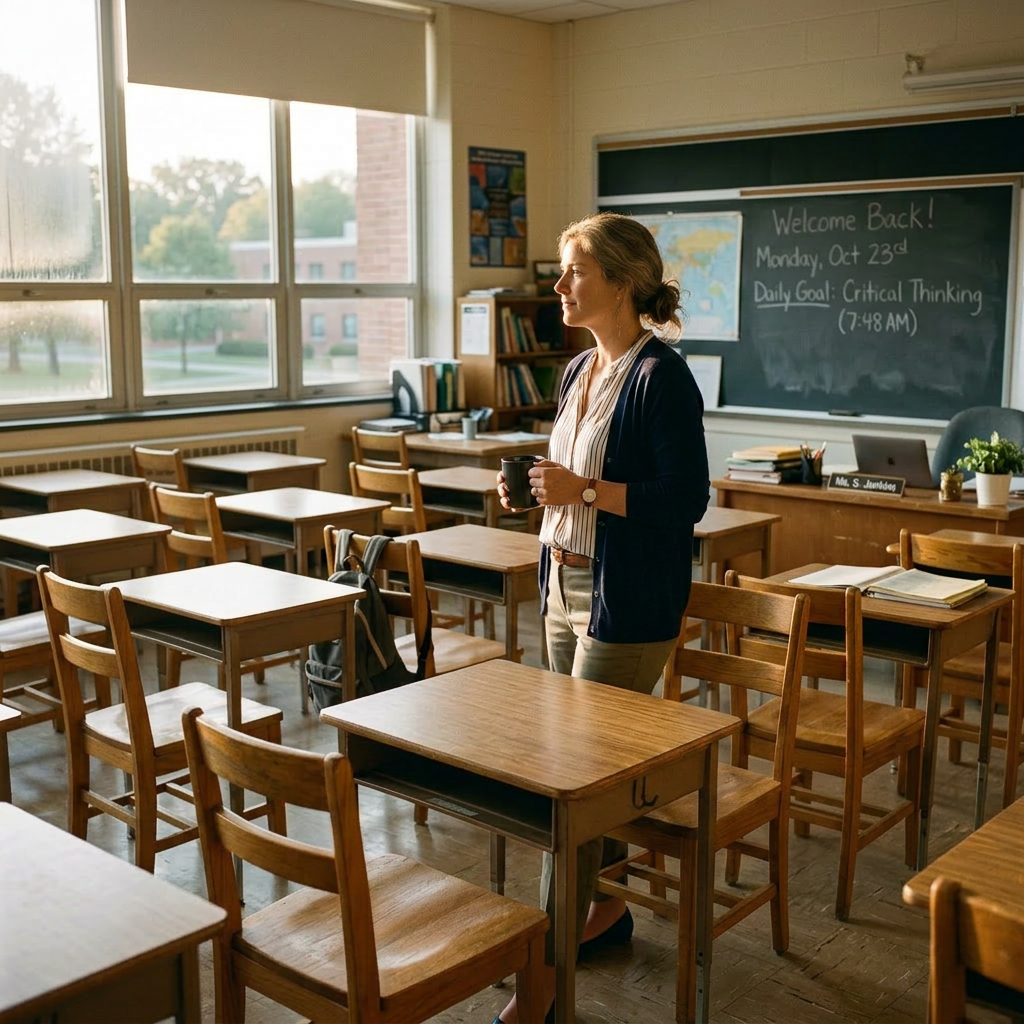
Teachers are part of the method.
By performative skills, I do not mean turning teachers into performers.
I do not mean entertainment, theatrical display, exaggerated confidence, or “putting on a show”.
This is often the first misunderstanding.
Teaching is already performative because it is enacted in front of, with, and in response to other people. It happens through voice, body, space, timing, attention, emotion, judgement and interaction.
A lesson is not simply delivered.
It is lived.
It is felt.
It is interpreted.
And this is why performative skills matter.
What are performative skills?
Performative skills are the embodied, relational and interactional skills through which teachers shape how learning is experienced in real time.
They are the skills through which a class feels:
held, but not controlled;
challenged, but not threatened;
visible, but not exposed;
energised, but not overwhelmed;
supported, but not dependent.
They include the teacher’s use of voice, gesture, movement, eye contact, facial expression, silence, proximity, posture, pacing and response.
But they are not just physical skills. They are also skills of judgement.
What does this moment need?
Do I step in or stand back?
Do I speak or wait?
Do I correct now or later?
Do I increase the energy or calm things down?
Do I hold the group’s attention or allow space to emerge?
These decisions happen constantly in classrooms, often in seconds. They are part of the craft of teaching, but we do not always name them clearly enough.
Performative skills are not charisma
Performative skills are not about having a “big” personality.
They are not about being funny, dramatic, extroverted or endlessly energetic.
In fact, some of the most powerful teacher presence is quiet.
A calm pause before responding to a learner.
A warm look that says, “Take your time.”
A slight shift in position that gives a pair more independence.
A lowered voice that settles the room.
A moment of silence that allows thinking to happen.
A teacher does not need to perform at learners.
The teacher needs to be aware of how their presence is functioning with learners.
That is a very different thing.
Voice, gesture and silence are part of pedagogy
In teacher education, we often focus on visible procedures.
Was the task set up clearly?
Were the instructions effective?
Was the language analysed accurately?
Was feedback managed appropriately?
These are important questions. But they are not the whole story.
How the teacher gives the instruction matters.
A teacher can ask the same question in a way that invites thought or demands performance.
A teacher can correct the same error in a way that protects dignity or increases anxiety.
A teacher can stand in the same room in a way that opens participation or closes it down.
Voice matters.
Gesture matters.
Timing matters.
Silence matters.
Movement matters.
Facial expression matters.
Response matters.
These are not decorative additions to teaching. They are part of how teaching works.
Learners read the signals
Learners do not experience teaching only through content.
They experience it through human signals.
Am I safe here?
Am I being judged?
Does the teacher want to hear from me?
Is it okay to be wrong?
Will I be rushed?
Does my contribution matter?
These questions shape what learners are willing to do.
A learner who feels safe may risk an answer.
A learner who feels exposed may withdraw.
A learner who feels recognised may participate more fully.
A learner who feels dismissed may stop trying.
This is especially important in language classrooms, where participation often involves vulnerability. Speaking another language in front of others is not a neutral act. It can involve embarrassment, uncertainty and fear of failure.
The teacher may think they are simply managing a task.
But the learner may be experiencing something much deeper:
I am capable.
I should stay quiet.
My voice matters.
I do not belong here.
This teacher believes in me.
Performative skills matter because teacher behaviour can influence these interpretations.
From “What did I do?” to “What did my action signal?”
Teachers are often encouraged to reflect by asking:
What went well?
What did not go well?
What would I change next time?
These are useful questions. But for performative development, they are not enough.
We also need to ask:
What did my behaviour signal?
A teacher may say:
“I corrected the learner quickly because I wanted to help.”
But what did the correction signal?
It may have signalled attentiveness and support.
Or it may have signalled that errors are dangerous, speed matters more than thought, or the learner’s attempt was not valued.
The same action can be interpreted differently depending on tone, timing, relationship and context.
This does not mean teachers should become anxious about every gesture or word. That would be impossible.
But it does mean teachers need to become more curious about the meanings their actions may produce.
Meta-performative awareness
This is where meta-performative awareness becomes important.
Meta-performative awareness is the teacher’s ability to notice and reflect on the meanings their behaviour may be producing in the classroom.
It is the awareness that teaching actions do not simply carry out procedures. They also send relational and emotional messages.
A teacher who constantly fills silence may intend to maintain pace, but learners may receive the signal that thinking time is not allowed.
A teacher who praises only quick answers may intend to encourage participation, but learners may receive the signal that speed is valued over depth.
A teacher who stands over a group to monitor may intend to support, but learners may feel inspected.
A teacher who corrects publicly may intend to help everyone learn, but one learner may experience shame.
Meta-performative awareness asks teachers to look beneath the surface of classroom management and consider how their actions are being interpreted.
Who felt invited in?
Who may have felt overlooked?
Where did my support become control?
Where did my energy become pressure?
Where did my silence help?
Where did my intervention close something down?
These are not easy questions, but they are essential ones.
Why teacher education needs this language
Without a language of performative skills, teacher education often falls back on vague comments.
“Build rapport.”
“Be more engaging.”
“Use your presence.”
“Create a better atmosphere.”
“Respond more naturally.”
But these comments can leave teachers asking: how?
A performative lens helps us become more specific.
Instead of saying, “Build rapport,” we might ask:
How did you acknowledge learner contributions?
How did you show you were listening?
How did your facial expression respond to uncertainty?
How did you make risk feel manageable?
Instead of saying, “Be more confident,” we might ask:
How did your voice carry?
Did your pacing support the room?
Were your gestures purposeful?
Did you allow yourself to pause?
This is much more useful than treating presence as personality.
It gives teachers something to notice, practise and develop.
The teacher is part of the method
In ELT, we often talk about methods, approaches, techniques, tasks and materials.
But the teacher is not simply the person who delivers the method.
The teacher is part of how the method is experienced.
A communicative activity can feel liberating or threatening.
A correction stage can feel supportive or humiliating.
A discussion task can feel energising or exposing.
A learner-centred classroom can feel genuinely empowering — or strangely abandoned.
The difference often lies in the teacher’s performative judgement.
How is the task framed?
How is risk managed?
How is participation invited?
How is error handled?
How is silence held?
How are learners recognised?
This is why performative skills are not an optional extra.
They are central to the lived experience of learning.
A final thought
The teacher’s body, voice and presence are not separate from pedagogy.
They are not soft extras.
They are not personality traits.
They are not magic.
They are part of how pedagogy happens.
And if we want teacher education to take the human dimension of teaching seriously, we need to bring these skills into view.
We need to name them.
We need to observe them.
We need to rehearse them.
We need to reflect on them.
Because teaching is not only what we plan.
It is what learners experience when our plans meet the living reality of the classroom.
Discover more from Teaching Artistry
Subscribe to get the latest posts sent to your email.

