
Beyond “Just Speaking”: Developing Speaking Skills with Purpose
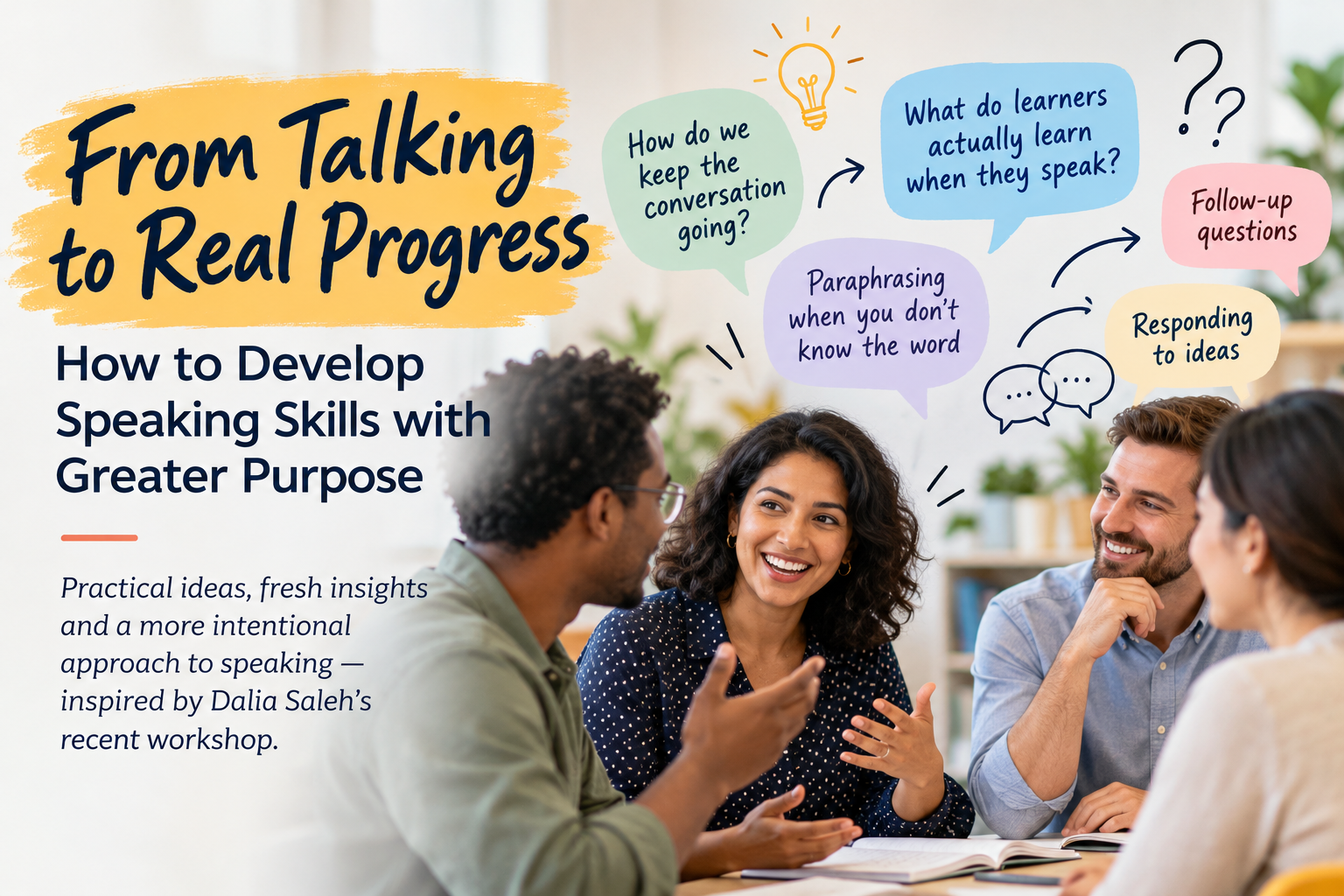
Speaking lessons are often lively. Students discuss interesting topics, work in pairs, use useful phrases and spend plenty of time talking.
But are they actually becoming better speakers?
That was the central question in Dalia Saleh’s workshop, Beyond “Just Speaking”: Developing Speaking Skills.
Dalia began by giving participants a short speaking lesson. They discussed working from home and used expressions such as “from my perspective” and “I couldn’t agree more”. It felt like a familiar and effective speaking activity.
Then she asked a different question:
What did you actually learn to do better as a speaker?
That question changed everything.
Speaking practice is not always speaking development
Learners may speak a lot without developing a particular subskill.
They may express opinions, but not know how to maintain interaction.
They may talk in pairs, but rarely ask follow-up questions.
They may communicate successfully, but struggle to paraphrase when they cannot find a word.
They may speak at length, but organise their ideas poorly.
This means that a speaking lesson needs more than a topic and a discussion task. It needs a clearer sense of what learners are trying to improve.
Instead of asking only:
“What will my learners talk about?”
we can also ask:
“What do they need to become better at doing while they speak?”
That might mean developing fluency, organising turns, paraphrasing, responding to a partner, asking follow-up questions or keeping a conversation going.
Teaching Artistry as purposeful attention
This connects strongly with Teaching Artistry.
Teaching Artistry is not only about creativity, charisma or engaging activities. It is also about attention.
What is the teacher listening for?
What do we notice when learners interact?
A learner who hesitates repeatedly may need more than “speaking practice”.
A quiet learner may need support with interactional strategies.
A learner who stops whenever they forget a word may need ways to paraphrase or describe.
The more carefully we notice what learners are actually doing, the more useful our teaching choices become.
Diagnose before you intervene
One of the useful principles in Dalia’s workshop was to start with the learner difficulty.
Different speaking problems require different kinds of support.
A learner who pauses after every few words may need planning and fluency work.
A learner who cannot find vocabulary may need communication strategies.
A learner who does not respond to their partner may need help with small interactional moves such as reacting, picking up an idea and asking a follow-up question.
Speaking is not one skill.
It is a collection of behaviours that teachers can help learners notice and practise.
Making the invisible visible
Many of the skills involved in successful conversation are easy to overlook.
Fluent speakers react naturally, ask questions, repair misunderstandings and build on what others say.
Learners may not know how to do these things yet.
The teacher’s role can be to make these small moves visible.
A simple dialogue can become a noticing task:
What keeps the conversation going?
Where does one speaker respond to the other?
Which question encourages the speaker to continue?
Learners can then try the same strategies in their own conversations.
The teacher as designer of attention
This offers a useful way of thinking about Teaching Artistry:
The teacher designs attention.
We help learners notice language.
We help them notice how interaction works.
And we train ourselves to notice what learners need.
That also changes monitoring.
Instead of simply asking, “Are they speaking?”, the teacher can listen for something more specific:
Are they asking follow-up questions?
Are they extending one another’s ideas?
Are they paraphrasing?
Are they organising their turns more clearly?
The clearer our attention, the more purposeful our feedback becomes.
Beyond “just speaking”
A good speaking lesson does not always need more activities.
Sometimes it needs a sharper focus.
Not only:
“What topic will they discuss?”
But:
“What will they become better at doing as speakers?”
That small shift moves us from activity to intention.
From talking to development.
And from managing speaking tasks to developing the human skills that make communication possible.
That is where speaking pedagogy becomes part of Teaching Artistry.
Discover more from Teaching Artistry
Subscribe to get the latest posts sent to your email.

