
What If Your Students Were Your Coursebook?
Your lesson starts in five minutes.
Your computer isn’t working. Your carefully prepared materials are unavailable. All you have is a whiteboard and a marker.
Could you still teach an effective lesson?
This was the scenario that opened Irem Sahsinem Lee’s workshop on Dogme ELT — an approach that challenges us to rethink where learning opportunities come from.
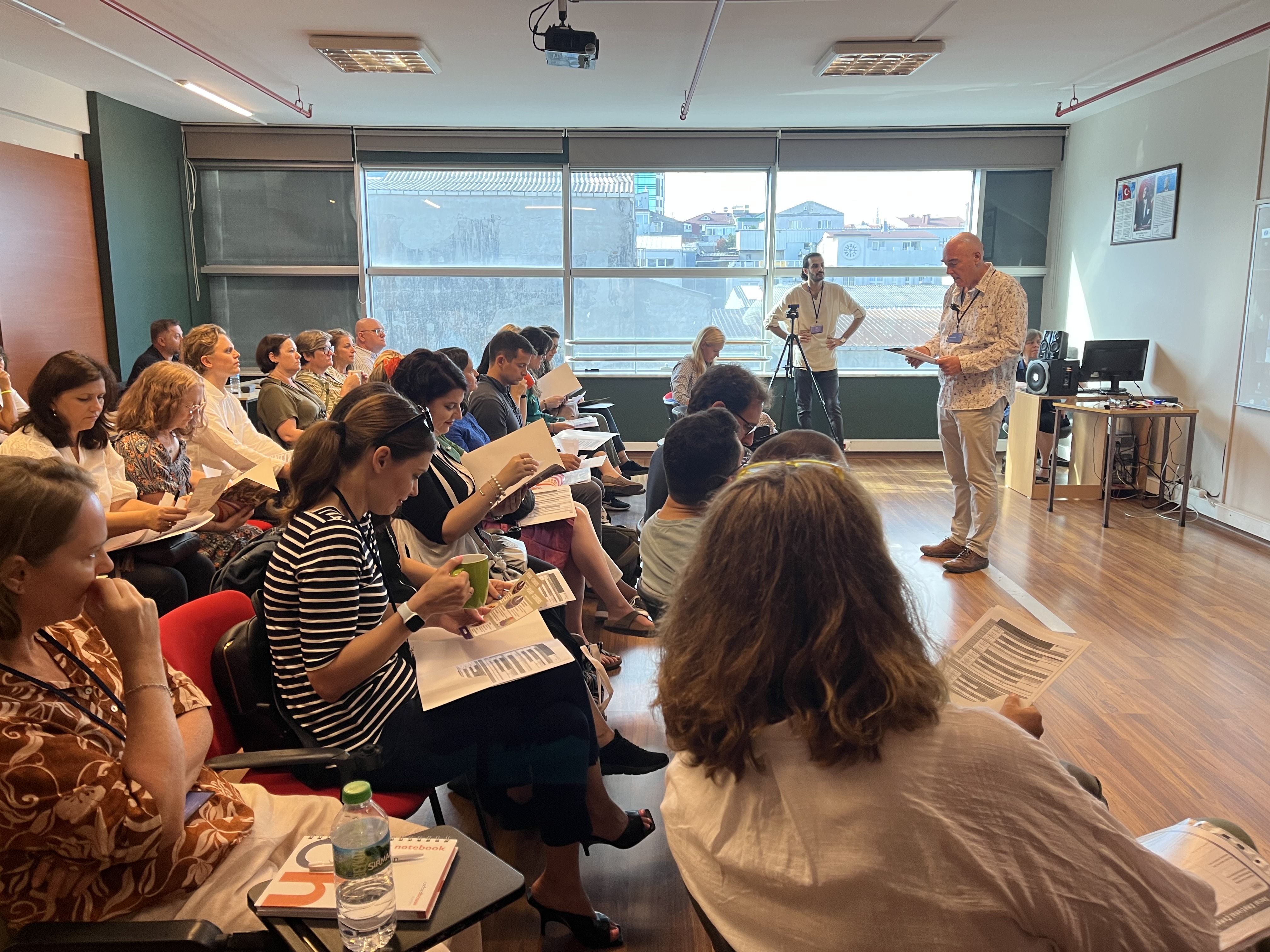
The resources are already in the room
Dogme ELT is based on three central principles:
- Conversation-driven learning
- A materials-light approach
- A focus on emergent language
Instead of relying primarily on prepared materials, the teacher draws on learners’ experiences, interests, ideas and the language that emerges through meaningful interaction.
This does not mean abandoning materials altogether.
It means recognising that some of our most valuable teaching resources are already sitting in front of us.
More than just conversation
An important distinction Irem made was that Dogme is not simply having a chat with learners.
The teacher has an active and demanding role.
While learners are communicating, the teacher is listening, noticing, identifying difficulties and recognising opportunities for language development.
Irem demonstrated how teachers can work with emergent language in three ways:
- Improve accuracy by addressing errors.
- Upgrade language by offering more effective or natural alternatives.
- Extend learners’ language by introducing useful expressions.
A learner talking about a boring experience, for example, might discover expressions such as counting down the minutes or I couldn’t wait to go home.
The language becomes immediately relevant because it comes from something the learner wanted to communicate.
Creating materials in the moment
One of Irem’s most interesting ideas was to think of learners’ contributions as raw material.
The teacher takes that raw material, notices its potential and transforms it into learning opportunities.
The language can be recorded, practised and revisited in subsequent lessons.
The materials are not necessarily created before the lesson.
They emerge during it.
A photograph, a treasured personal possession, an everyday problem or an unexpected experience can become the starting point for meaningful language development.
Does less preparation mean less teaching?
Not necessarily.
A materials-light lesson still requires preparation, but perhaps a different kind of preparation.
Rather than anticipating everything that will happen, the teacher prepares to respond to what might happen.
This requires careful listening, language awareness, flexibility and professional judgement.
It also requires a willingness to relinquish some control and trust learners to contribute to the direction of the lesson.
A Teaching Artistry perspective
Irem’s workshop captures something fundamental to Teaching Artistry: the distinction between delivering a lesson and creating a learning experience.
The artistry lies in noticing possibilities, responding to the unexpected and transforming ordinary human interaction into meaningful learning.
A lesson is not simply a script to be followed.
It is a social event shaped by the people participating in it.
Perhaps the most valuable teaching resource is not the one we spent hours preparing the night before.
It is the conversation we haven’t had yet.
Discover more from Teaching Artistry
Subscribe to get the latest posts sent to your email.


Good to be reminded of these points! Sometimes not having materials in hand leads to an even more productive and engaging lesson.
I’ve experienced that.
Thanks for sharing the ideas!