It hs been great working on collaborative research into Teacher Education in Turkey with the members of ELTER. We have just had yet anpther article published although I must confess my contribution was modest.
As an ELT teacher and teacher educator, I have seen firsthand the limitations of traditional teacher training practice. Too often, teacher training programs focus on developing teaching competencies, such as procedures, routines, and lesson planning, at the expense of activities that develop performative skills such as building awareness of self, others, and environment (group dynamics, building trust, rapport). This focus on competencies leads to a teacher-centered approach to teaching, where the teacher is seen as the expert who imparts knowledge to the students.
I believe that teacher education should be more heuristic and focus on teacher improvisation, embodied practices, and emergent understandings. This means that teacher training programs should focus on helping teachers develop their own unique teaching styles and approaches, rather than trying to fit them into a mold. It also means that teacher training programs should focus on helping teachers develop their own understanding of teaching and learning, rather than simply providing them with a set of pre-determined methods and techniques.
The current hegemony of learner-centered methodology is a case in point. Most teacher education programs claim to be learner-centered, but in reality, they operate on a trainer-led transmission model of education. This means that teachers are taught how to deliver a set of pre-determined lessons, rather than being given the opportunity to develop their own teaching styles and approaches. As a result, teachers often feel stifled and unable to be creative in their teaching.
I believe that teacher education should be about more than just developing teaching competencies. It should be about helping teachers develop their own unique teaching styles and approaches, and their own understanding of teaching and learning. This can only be achieved through a heuristic approach to teacher education that focuses on teacher improvisation, embodied practices, emergent understandings and activities to encourage reflection on individuals’ identities as teachers.
Here are some specific suggestions for how teacher education can be made more heuristic:
Provide opportunities for teachers to reflect on their own teaching and learning through participatory activities.
Encourage teachers to experiment with different teaching styles and approaches.
Create a supportive environment where teachers feel safe to take risks and experiment.
Provide opportunities for teachers to collaborate with other teachers to build trust, collaboration and personal disclosure.
Offer professional development opportunities that focus on developing facilitation skills.
I believe that by making teacher education more heuristic, we can help teachers become more creative, innovative, and effective educators.
Find the solutions to your problems with the support of a community of teachers.
The workshops will be Saturday 9.30 – 12.30; 13.30 – 16.30 and
+ Forum Theatre presentation to an invited audience at 17.30 – 20.30.
These series of workshops explore the use of participatory approaches to professional development using techniques based on Forum theatre inspired by the work of Augusto Boal.
The workshops are structured on tried and proven methodology adapted from Applied Theatre and used for training in community settings, care homes, hospitals and many institutions focusing on personal and professional development.
In the first workshop we do activities to raise awareness of our context and brainstorm challenges and problems in our professional lives. In the second workshop these issues are explored and re-enacted in short dramatic scenarios. In the third workshop these challenges are presented to an invited audience to find solutions and alternatives.
The main advantages of this bottom-up approach to professional development are firstly, it is participant centered (the issues are real concerns and challenges of the participants), secondly the dramatic scenarios provide a safe space and frames the reflection and discussion distancing participants in a fictional world where solutions can be explored without repercussions in the real world while still recognizing their real-world relevance. Finally, the methodology generates multi-voiced, multi-perspectival dialogue and is focused on finding solutions to real problems and inspiring action and change.
Join presenter, Tom Godfrey, on Saturday 1 April at 15.00 UK time as he demonstrates how to develop drama facilitation skills in ELT. In the webinar, Tom will suggest that teaching needs to be conceived more as a performative art requiring practitioners to develop skills of a performer rather than a scientific discipline prioritising subject knowledge and procedural techniques. Come and join the discussion by registering below.Anyone is able to attend this webinar, free of charge, but only IATEFL members will receive a certificate of attendance and access to the recording afterwards. For more information and details about how to register, please keep reading!
Developing facilitation skills
Performative Teaching: How to develop Drama facilitation skills in ELT Date: Saturday 1 April 2023Time: 15.00 UK time (check the time in your location). This webinar addresses how Applied Theatre (drama) can inform EFL Teacher Education. Typically, Teacher Education is perceived as a scientific discipline prioritising subject knowledge and procedural techniques. In the webinar I suggest teaching needs to be conceived more as a performative art requiring practitioners to develop skills of a performer. Undoubtedly there are similarities between teaching and performance, not least the fact that teaching involves dealing with human beings and requires the physical presence of teachers and learners and a physical, mental and emotional engagement between them.The webinar considers, if teaching is considered as a performative art, what performative and meta-performative skills are necessary for successful practice? How can drama methodology be used in ELT teacher education? How can teachers use drama in their professional lives and what additional facilitation skills do they need to utilise drama techniques in the classroom effectively and having identified what those skills are, how can teachers acquire these skills? What are the barriers that need to be overcome?
PRESENTER: Tom Godfrey Tom has always had a passion for the theatre having directed and acted in many shows while working as an EFL teacher and teacher trainer around the world. These two interests recently aligned as he completed an MA in Applied Theatre at Exeter University focusing on how Applied Theatre can inform Teacher Education. Tom is the Director of International Training Institute (ITI) which is a centre for teacher training and development and an ELT consultancy. He completed an MA TEFL at Reading and Ed.D at Exeter University, UK. He also delivers workshops on using Drama in ELT and Forum Theatre for Teacher Development. He is founder of Speech Bubbles Theatre Group which performs to raise money for charities that support education and children in Turkey. Additionally, Tom is making a documentary film about the experiences of training to be an ELT teacher.
Led by Daniel Foley, a professional actor, who has performed in 64 countries worldwide; his one-man shows have received critical acclaim and he is the founding member of his current theatre company “Performance Exchange.” The workshop includes techniques used by professional actors to project, modulate and develop their voice.
Daniel Foley is a well-known Shakespearean specialist. His one man show brings alive all areas of Shakespearean Drama, from the tragic and macabre to the comic and historic with scenes from “Romeo and Juliet”, “Macbeth”, “Hamlet”, “The Tempest”, amongst others, with significant aplomb and participation of members of the audience. Highlights include impersonations of Marlon Brando and John Wayne taking on Shakespearean roles and an insight into some of the techniques used in hand and sword fighting on the stage. Daniel also shares his knowledge of Elizabethan theatre and tests the audience’s knowledge through an interactive quiz.
Developing Facilitation Skills for Trainers and Educators
Face to face courses at ITI Istanbul.
The course develops advanced facilitation skills and is aimed at anyone who is involved in training, development and educating others. Facilitation skills are vital in any event that involves creating a safe space for collaboration where people are interacting and discussing ideas to promote change. The workshops explore the use of participatory approaches to professional development such as team building, gaining participants’ trust, maximizing engagement and fostering collaboration and personal disclosure and simultaneously develops a range of many other performative skills. The workshops are structured on tried and proven methodology adapted from the participatory arts and used for training in community settings, care homes, hospitals and many institutions focusing on personal and professional development.
Participants will receive a certificate at the end of the course.
These series of workshops explore the use of community forums in personal and professional development. The workshops are adapted from techniques used in Forum Theatre devised by the Brazilian dramatist Augusto Boal.
Participants will learn the methodology and practice the techniques so after the programme they can apply these methods in their own contexts. This methodology provides an innovative framework for conducting professional development in institutions. It is participant (or company) centered (the issues are real concerns and challenges), while providing a safe space to frame the reflections and discussions. The methodology generates multi-voiced, multi-perspectival dialogue and is focused on finding solutions to real problems and inspiring action and change.
This paper is based on a series of diagnostic workshops conducted at a teacher training centre in Istanbul focusing on how participatory methodology can inform ELT Teacher Education. The workshops provided participants experience of participatory methodology and techniques to elicit feedback on their pedagogic value and efficacy in Teacher Education. Through dialogue and reflection, participants identify the facilitation skills they value from the workshops. While participatory methodology has a long and proven track record in Applied Theatre, education and development, it is rarely utilized in teacher development programmes. In particular we explored the use of Community Forums (an adaption of Forum Theatre) in which participants re-enact collectively experienced challenges in order to find solutions. Feedback from the workshops reveals that Community Forums provide participant-led, solution-oriented, multiple voiced opportunities for reflection and dialogue on critical incidents teachers’ face. Additionally, the workshops aim to initiate transformational change by developing participants’ facilitation skills. The research provides the initial diagnostic data to create teacher development programmes incorporating Community Forums and participatory methods.
1 Introduction.
Having just attended a series of professional workshops I am struck by a worrying paradox. Most ELT trainers and educators, while advocating lessons that are personalised, learner-centred and focus on communication and language use; in practice deliver training sessions that are tutor-centred, material driven (invariably structured by power point slides) that appear to aim primarily at the transmission of content. If trainers and educators do not set an example of how to encourage participatory learning, it is hardly surprising then that teachers often pay lip service to the concept of ‘facilitating learning’ while in reality they are stuck in the traditional conception of a teacher as a transmitter of information. We sorely need a framework and structured methodology for participant-led, solution-oriented professional development workshops.
One solution may lie in the methodology provided by the participatory arts. Participatory arts provide a form of expression which enables shared ownership of decision-making processes and aims to generate dialogue, reflection, and community cohesion. Adapting the principles and rationale of Forum Theatre I explored the use of participatory methodology (and Commubnity Forums in particular) for teacher professional development in a series of workshops at a teacher training centre in Istanbul. Community Forums are an adaptation of Forum Theatre which was developed by the Brazilian educator, dramatist, director Augusto Boal in 1973. Rooted in the Brazilian social movements of the 1950s and 1960s and based on Paolo Freire’s model of participatory education, it is designed to represent experiences of social and political oppression in order to stimulate community dialogue and problem-solving. Over 50 years later Forum Theatre has been shown to work successfully across a remarkable range of cultural, political, and social differences and demands. It has been used by peasants and workers, students and teachers, artists, social workers, psychotherapists, and NGOs, among others; in schools, streets, churches, hospitals, theatres, and prisons.
Community Forums can be seen as a methodology for generating both the participants’ understanding of their situation and the actions to improve them so, in other words, it provides both the content (problems) and the methods to interrogate reflection and elicit solutions. The procedure is relatively straight forward and easy for a novice facilitator to follow after basic training. Participants (teachers in our case) are invited to brainstorm and recall crtiical incidents from their experience of challenges / problems they have faced in their work and then share experiences with each other prior to re-enacting the scenarios in groups in order to reflect and diagnose solutions and alternative courses of action. Having investigated and rehearsed a number of scenarios, these then can be scaled up to a wider community by presenting them to an audience and inviting them to discuss and offer alternative solutions. The workshops aim at the education, personal growth and skills development of the participants as well as providing a diagnostic exploration of the efficacy of applying community forums in a professional development setting.
3 Objectives
My specific objectives for the workshops are fourfold.
1. Diagnostic: To provide an opportunity to experience community forums and to elicit participant-led feedback on their efficacy for teacher education.
2. Methodologic: Related to the above, to evaluate whether the methodology is appropriate and effective in teacher education settings (does it do what it claims to do).
3. Pedagogic: To elicit through dialogue and reflection what participants have learned from the workshops.
4. Transformational: To initiate action or change by providing opportunities to develop facilitation skills for participants to utilize in their own settings.
4 Procedure
The workshops were structured according to two components:
A.) Games and participatory activities and B). Community Forum interrogating the challenges of being an ELT teacher and eliciting creative solutions
A. Games and participatory activities.
The activities are designed to build and/or develop most, if not all, of the following:
The workshop structure relies on participation. Firstly, the workshops are built on the participants’ personal narratives and experiences. Sharing personal stories can be a powerful way of promoting teacher development through the sharing of experiences (McCabe 2002). Secondly it is inherently educational as the reflective and interactive processes promote self-aware, critically thinking participants. It encourages a ‘bottom up’ approach to change that is advocated in much literature on educational innovation and change (Fullan 2007).
The three (3 hour) workshops followed this format.
Workshop 1. Tilling the Soil.
Participants warm up to the concept of self-disclosure through activities in pairs and groups. Then we brainstorm the rewards of teaching before relating a story of positive achievement in groups which provides the stimulus for re-enacting the story through image theatre. In the final hour we repeated the cycle but this time brainstorming – challenges, obstacles, difficulties, and concerns of an ELT teacher.
Workshop 2. ‘Sowing the Seeds’
Participants focus on devising scenes for the community forum scenario. By the end of the workshop we have six scenes and a facilitator/ director allocated to each scene.
Stage 3 ‘Blooming’
Participants focus on developing facilitation skills and rehearsing the forum scenes. The scenarios are pressented to an audience in the Community Forum. The forum aims to stimulate discussion, reflection and debate amongst the audience who are also invited to participate in the search for solutions to the issues raised.
5 Findings and participant feedback
5.1 Real experiences / challenges
The aim of the community forum was to raise awareness and interrogate the challenges that teachers face and to explore solutions. After the first workshop I categorized these challenges into four groups for ease of reference:
1. Internal challenges (self-doubts, moods, energy levels, lack of confidence / knowledge)
2. External challenges (from administration, management, learners, parents and colleagues)
3. Contextual challenges (low pay, large classes, inappropriate methodology and materials)
4. Cultural challenges (poor communication, long hours, cultural differences)
When planning the workshops, I was concerned that the scenarios presented to the audience would lack authenticity. However, these comments suggest otherwise:
‘It shows the challenges of a teacher. It is nice to know you are not alone experiencing these kind of problems’
‘It mirrors real situations and presents them visually’.
Indeed, one audience member embodied the experience:
‘In the beginning I was so tense and I felt I was exactly the same as Asya (the protagonist), I even felt blank in the first 10 seconds after the show was over. Felt frustrated but then I started thinking how I could help her… things changed. I started to feel more confident. I could think outside the box again. I felt relieved.’
At the end of the second workshop one participant recognized that time and iteration are necessary for depth and wrote: ‘I believe this kind of training will be more ‘fruitful’ if done several times. I mean problems to focus on will get more challenging and therefore the issues raised will be more thought provoking.’
5.2 Metaxis / dramatic distance.
Participants noted that re-enacting the fiction provided space for reflection. Boal (1995, p.43) refers to the term metaxis to describe the idea of living in an imaginary world which creates a dialectic between fiction and reality so knowledge acquired in the fictional world is transferable to the real world through imaginative play. The benefits of drama to provide ‘distance’ was mentioned by participants as in these examples: ‘I think they open some doors and give perspective about real life problems. Watching other people and seeing the problems acted provides a distance from the problem. So I can think better to find a solution.’
When dramatizing critical incidents participants experience a condition of in-between-ness, a liminal space between reality and fiction. This duality creates both tension and imaginative possibilities that are crucial elements in a training context. Through imagining what it might be like to be another, at the same time as being themselves, participants experience ‘me/not me’ (Schechner, 1985). Transformative theories of learning (Mezirow, 1997) propose that learning occurs when the participant faces a challenge, either an accumulation of experiences over time or a sudden trauma. The state of disequilibrium triggers reflection and critical assessment.
5.3 Reflection and Dialogue.
When prompted to consider the benefits for professional development two comments from the audience included:
‘Confidence, talking about the issues via fictional characters makes people feel better (a bit of therapy) becoming more aware of what happens in their schools’.
‘Imagined situations may be perceived as less confrontational’
Each scenario in our performance highlighted problematic issues involving our teacher protagonist facing challenges. At the end of the event, we had a feedback discussion in which the audience reflected on the experience.
5.4 Participant-led.
By delegating content creation to the workshop participants, the conventional power discrepancy is overturned allowing for participant centred input. This flexibility in facilitation allows for creation of a zone of proximal development for the participants and shifts the responsibility for learning from the facilitator to the participants (Vygotsky, 1986). The zone of proximal development is a concept introduced by Vygotsky to describe the space between ‘not able to do’ and ‘able to do’. In this space participants seek solutions with support from the audience.
One key objective of the workshops is to assess their pedagogic value. One factor that emerged was that as the content was participant led, this allowed space for creativity. One participant commented: ‘It was lovely watching the things that were crafted by people, from nothing‘.
5.5 Change and transformation
A key aspect of the methodology is the degree of change and transformation of the participants. In the final workshop I invited participants to comment on how the workshops assisted in their professional development. Many comments referred to the methodology itself; ‘Creating alternative solutions, scenarios, paths of experience’; ‘Exploring issues that concern teachers can clarify things and help find solutions;’ Many participants commented on the relationship between challenge and enjoyment: ‘It was scary at first, but then, it was fun’. In terms of learning and development there is a need for challenge, as Sawyer (1999) highlights: ‘Change is always connected to the willingness to take risks in going beyond what is known and familiar’.
5.6 Scalability
One key advantage of community forums in terms of teacher development is that the procedure can be scaled up to involve large numbers of participants in a short time period. Simply by training an initial modest cohort of 12 community forum facilitators, if these facilitators subsequently conduct workshops for a further 12 participants and then present their community forums to audiences of 200 teachers, within a limited period more than 2,500 teachers will have been exposed to the issues and had an opportunity to discuss and generate solutions. The forums can be expanded to include other stakeholders such as School Principals, learners, and parents. In addition the impact of the forums in terms of audience responses and committment to finding solutions is visible. The forum can be filmed and/ or audience feedback obtained to provide tangible evidence of impact to sponsors.
5.7 Limitations
One audience member recognised that a representative range of stakeholders are needed to have a genuine interrogation of the issues: ‘Through these workshops we can actually educate heads of department, principals of schools, managers and even teacher trainers in order to create a healthier working environment.’
When asked whether institutions would be interested in professional development using Community Forums there was a mixed response. ‘The institutions are interested in making money. I think they don’t care for using professional development that needs a lot of time and costs a lot maybe’.
‘Here is the point, sometimes people prefer the old-fashioned techniques (books, homework and old rules) so they are not accepting new things.’
6 Conclusion
Community Forums operate at the facilitative, open end of the teaching / training continuum and therefore are liable to elicit more fervent participant responses, interaction and dialogue. Community Forums epitomise an interactionist, participatory approach to learning espousing the philosophy that the process of meaningful dialogue and interaction and the flow of ideas is where learning occurs.
We can conclude by revisiting our initial objectives for the workshops.
1. Diagnostic.
The workshops generated reflection and discussion that provided valuable information about participants perspectives of Community Forums and its relevance to their development as teachers.
2. Methodology.
Despite some limitations, such as potential lack of acceptance by institutions and other stakeholders, we can conclude that Community Forums provide participant-led, authentic content to generate solution oriented interventions, reflection, and dialogue of lived experience as well as offering a safe, fictional distance to encourage personal disclosure and multiple perspectives.
3. Pedagogic
Participants identified numerous facilitation skills that emerged primarily through the games and activities. The methodology provides participants opportunities to develop facilitation skills of raising their awareness of self, others and reflect on their beliefs, behaviour and feelings. These facilitation skills are rarely addressed in teacher education where the focus is primarily on a cognitive, instrumental orientation rather than towards a performative-humanistic understanding of “teaching and learning with head, heart, hands, and feet” (Schewe, 2013, p. 7).
4. Transformational
My aim in conducting the workshops is to stimulate action and change. The workshops are a pilot project to explore the efficacy of Community Forums and how to develop the skills of facilitators who can then disseminate the methodology. After my initial diagnostic workshops I have created two short courses: 1) A week intensive training to develop facilitator skills; 2) Three (3 hour) workshops leading to a Community Forum (see Appendix A). The overall aim is to introduce teachers to a range of techniques to raise awareness of the participatory arts in general and the us of community forums in particular and reveal a fresh landscape of creative personalised expression, enjoyment and gratification.
Works Cited
Boal, A., 1995. The rainbow of desire: the Boal method of theatre and therapy. Routledge, London; New York.
Freire, P., 1995. Pedagogy of the Oppressed. Continuum, New York.
Fullan, M., 2007. The new meaning of educational change, 4th ed. ed. Teachers College Press, New York.
Mezirow, J., 1997. Transformative Learning: Theory to Practice. New Directions for Adult and Continuing , Volume 1997, pp. 5 – 12.
McCabe, A., 2002. A Wellspring for development. IATEFL Publications 82–96.
Schechner, R., 1985. Between theatre and anthropology. Philadelphia, PA: University of Pennsylvania Press.
Schewe, M., 2013. Taking stock and looking ahead: Drama pedagogy as a gateway for performative. Scenario: Journal for Performative Teaching, Learning and Research, Volume 8, pp. 5 – 23.
Vygotsky, L., 1986. Thought and language. Cambridge, Massachucetts: MIT.
7. Appendix
Developing Facilitation Skills for Trainers and Educators
These series of workshops explore the use of community forums in personal and professional development. The workshops are adapted from techniques used in Forum Theatre devised by the Brazilian dramatist Augusto Boal.
Participants will learn the methodology and practice the techniques so after the programme they can apply these methods in their own contexts. This methodology provides an innovative framework for conducting professional development in institutions. It is participant (or company) centered (the issues are real concerns and challenges), while providing a safe space to frame the reflections and discussions. The methodology generates multi-voiced, multi-perspectival dialogue and is focused on finding solutions to real problems and inspiring action and change.
Are you thinking about starting a language school? If you are, I have set up three language institutions and am just about to start setting up a new language school for ITI, Istanbul so thought it a good idea to share some of the key considerations.
LOCATION
Things to consider here include choosing an area that is close to or easily accessible to your target market. Do you prefer to base the school close to your competition? Or do you prefer an area that doesn’t have a language school yet? Also consider public transport facilities. If you want to work with young learners, parents also need facilities for dropping off and picking up children. An area to park cars is important
LAYOUT OF ROOMS
Consider how many students you will have in each class and plan the space needed in classrooms. (Maximum 15 students in a class is normal). You might decide to target business clients which means some of your classes will be taught in their company. The advantage for you is that less room is needed on your premises. Also consider how much room you need for teachers and resources. You need a large teachers’ room with space for teachers to work. Computers and internet access. Plenty of cupboard space and filing cabinets for books and materials. Admin staff need a work area, too. Furthermore, you need a reception area for receiving clients and giving them information. A cafeteria for students waiting for classes. A self access room with computers for students’ use (see below).
RESOURCE ROOM FOR STUDENTS
Do you want to have a self-access centre for students to learn independently? (Also known as a multi-media centre). This can be a good selling point for the school. Busy clients might appreciate the opportunity to drop-by and study at times other than those set out for them in the traditional classroom setting. Teachers can be timetabled to oversee the centre which can be seen as a bit of “downtime” for them. You might decide that it can function without the presence of a teacher which makes it more economical. However, you’ll need somebody nearby to solve technical difficulties.
WHICH CLIENT GROUP TO TARGET
What kind of teaching will you focus on? Do you want to be specialised in teaching business clients? Do you focus on exam preparation? Or is your focus children and teenagers? Remember the additional considerations when teaching children e.g. security in the building and supervision at all times for the younger ones. The type of work you do also contributes to your corporate image, you can start thinking about this now. You can not mis children and business people at the same time.
HOW TO FIND YOUR CLIENTS
Think about where and how to advertise. How can you get your school known? The choice of publicity space will depend on your target market and the country you are in. What specialised press exists for your target market? Do you also want to contact Human Resource managers and/or training managers in large companies? Does the local Chamber of Commerce (or similar organisation) have a list of companies that you can target?
RESOURCES AND EQUIPMENT
Teachers usually need access to a photocopier and a computer. You need to decide how much to invest in these items and whether it would be easier to rent them. If the equipment is rented, you might get quicker after-sales service. So look into this area. Also contact large computer manufacturers directly and ask whether they are willing to give you computers at a reduced price. Explaining who your target clientele is might help you get computers at discounted price. The advantage to the supplier being that your students become familiar with the computer brand and therefore would be more likely to purchase one at a later date.
As for books, you need to decide whether you give the course book out to students. If so, this is factored into your course fees. The advantage here is that all students will have the book at the same time, making it easier for teachers. Alternatively, you can ask students to buy their coursebooks. Coursebooks have to be approved by the Ministry of Education.
As supplementary resources, I suggest that at the very least you need a book that covers each of the skills (reading, writing, listening, speaking) for each level. Grammar reference books and books that develop vocabulary and pronunciation are needed, too. Remember to buy cassettes and CD Roms to accompany coursebooks. Check with publishers and bookshops, they sometimes give discounts to schools.
If you decide to teach Young Learners, you’ll need other resources such as card, scissors, glue etc. A large quantity of toys, eg puppets, plastic fruit and veg will also come in useful. Story books and activity books will also be needed with YLs.
HOW TO FIND YOUR TEACHERS
You’ll need to consider where to advertise and what experience and qualifications you consider desirable. Probably the majority of teachers will be young (hopefully enthusiatic) and relatively inexperienced. They will need support from an experienced Director of Studies and a comprehensive programme of teacher development and regular observations.
ADMIN AND SUPPORT STAFF
You need to consider the job description of admin and support staff. The receptionists who deal with the customers directly on the phone and when they come to the school are key to the success of the number of students enrolling. They need throrough training. What exactly will you expect them to do? Do you need staff who speak English? Or is the local language sufficient? What about cleaning staff – will you employ them directly or will you outsource this work? You’ll also need to consider where to advertise for your admin and support staff and the same tips for recruiting teachers apply here.
DRAWING UP CONTRACTS
You’ll need to consider the legal aspects of work contracts in Turkey. If you are unsure about any aspect, get professional, legal advice. It is better to be safe than sorry.
Aspects to consider in the contract include: are you offering full-time, part-time or hourly-paid work? Is a trial period necessary before the contract is confirmed? What salary are you offering and what exactly is paid for, e.g. are planning and travel time paid and if so are they paid at the same rate as teaching? Will you pay for attendance at staff meetings?
Also consider what provisions you need to make for paying into pension schemes, health benefits, holidays and possibly luncheon vouchers.
LEGAL ASPECTS
You need to consider certain legal aspects of being an employer and providing a service. Your building will be used by the public so consider health and safety. This should be considered at the beginning, not later. It can be more costly to put something right once it is in place. Public use of the building also raises issues about insurance.
As for employees, you need to consider equal pay, maternity leave and the right to return to work. Think about issues concerning the termination of contracts. This may seem strange when you are about to recruit; but it’s better to know how to end a contract before you enter into it.
COMPETITION
You need to think about your competitors and how to position yourself in relation to them. What is the added advantage of studying with you rather than a competitor? This is your selling point. Gathering information about other schools helps you fine tune which products you offer and helps you find a niche in the market.
FEES
Issues to consider here include: will individuals be charged the same rate as companies? Will evening classes be the same price as mid-morning classes? How will prices vary according to whether it’s a group class or a one-to-one class?
You need to cover your costs, so factor in teachers’ salaries, overheads such as rent and electricity. Also consider the cost of materials (books and handouts) and admin salaries in order to calculate the cost of a teaching hour.
ACCOUNTS, BOOK KEEPING AND FINANCIAL ASPECTS
BUSINESS PLAN
It’s wise to have a medium-term development plan. Think about your objectives over the next 3 or 5 years. You might need to produce such a plan in order to get a bank loan. It will act as proof that you have thought out your project thoroughly. It’s also beneficial to you as it will keep you focused on your priorities.
COURSES: LEVELS AND TESTS
In general courses can be divided into 48 hours. Either 6 hours a week (8 weeks) or 4 hours a week (12 weeks) – (maybe an intensive daytime course of 12 hours). Learners then pay and register for a complete course. A typical programme would be:
BEGINNERS – (48 hours)
ELEMENTARY – (48 hours X 3)
LOWER INTERMEDIATE – (48 hours X 3)
INTERMEDIATE – (48 hours X 3)
And usually classes higher than this have so few students they are not economical to run. It is worth considering becoming an examination centre to run Cambridge and other examinations. This is an extra source of income.
A full syllabus needs to be submitted to the Ministry of Education for approval. You can get a list of approved books from the Ministry. It is also a good idea to get a sample approval syllabus and just copy it for the initial approval. (This can then be changed to suit the needs of the students and institution). Publishers can help with this as well probably.
You need to decide what sort of test to use for placing your students in classes and consider how students pass from one level to the next. Also, what is your policy on repeating a level? You need to think about the work being done by the Council of Europe to standardise language testing across the various member states.
STORING INFORMATION
You need a way to store information on your students. Essentials include name, address, contact telephone number (useful in case a class needs to be cancelled and a number for a parent is essential when teaching YLs). You also need a record of the entrance test score. Useful info includes profession, age and known illnesses (e.g. epilepsy, essential if teaching children). Remember that the information you store will be covered by a data protection law and deal with it accordingly.
Recruitment is the process of getting the right person in the right job and so is a key to success in your school. All too often you have one hour with somebody to decide whether they’re going to fit into your school and your existing team. If you hire this person, you’re going to see them on a daily basis, you’ll be sharing in their successes and failures, and the image of your school could depend on their abilities. So you want to get it right.
Mistakes that are made can be costly and very time-consuming. If the person doesn’t fit the profile or doesn’t fit into your existing team, you might find yourself starting up the recruitment process again. On the other side of the fence, if the interviewee doesn’t get all the necessary info regarding the post and the school, they’re not in a position to make an informed decision. They can regret their decision later and leave you. Out of fairness to interviewees and to save yourself extra legwork later, you need to be clear, precise and focused. I think that an hour is a very limited time for both sides to make such major decisions and like to use the time to the full.
Before starting any recruitment process, it’s essential for you to know exactly what you’re looking for. As one very wise person said, “If you don’t know where you’re going, how will you know whether you’ve got there?” This sounds obvious but you’d be surprised by the number of recruiters who jump this essential step.
Have your goal or end point firmly in sight. For this, you’ll need to ask yourself a certain number of questions. Here are some suggestions:
Think about where your school is heading in the near future. For example, do you want to set up young learners’ courses? Do you want to expand the range of business courses offered? You won’t be looking for the same profile, so be clear to yourself about what you want.
If your school is likely to be expanding, do you want to hire an experienced teacher? This person could move into a post of responsibility later or have a role training and guiding less experienced teachers.
You also need to consider areas such as organisation, paperwork, report-writing. If your school (or one of your clients) insists on extensive paperwork, then you’ll be looking for a teacher who is happy with this.
Do you want to hire a teacher who is autonomous? If you have a lot of in-company classes the teacher will get much less moral and pedagogical support than the teacher who teaches mostly in the school.
Do you want to hire a full-time teacher on a permanent contract? This would increase the amount of commitment on both sides. Or do you prefer to hire one or two teachers on part-time contracts or hourly-paid teachers? These two options allow for more flexibility (both for you and the new teacher) for increasing and decreasing teaching hours.
You need to get Ministry of Education approval for teachers and a work permit. Often teachers need this before they enter Turkey and it can be a lengthy and time consuming process.
Once you know what you want, you’re almost ready to start looking. Before starting, it’s helpful to brainstorm the profile of the perfect candidate. You could consider three categories:
qualifications – is a university degree important for you? do you want someone who has the TEFL Cert or Diploma? Will you train the teachers yourself and so think that teaching qualifications are not necessary? I would suggest a minimum of a Certificate. Also a first degree in English may be necessary to get Ministry of Education approval. It is also an idea to consider running CELTA courses.
experience (type of teaching, number of years, countries, size of school)
personal qualities (adaptability, rigour, good with difficult people…)
From this wish-list, you can decide which elements are essential and which are an added advantage. This is your person specification (person spec) and will help you at every stage of the recruitment process.
Think about how you are going to check each item on your person spec. What can you check through asking for references? What will you ask the candidate in interview? How will you check certificates and diplomas? Will you ask the candidate to bring them to the interview? What will you ask the candidate on the phone before deciding whether to continue with the recruitment process? Remember that bringing someone in for an interview is very time-consuming for you and the person concerned. So get as much information as possible before inviting the candidate in.
Now you know what you are looking for, you’re ready to start. Here is my suggested procedure:
Place advertisement – make the school look seductive and attractive, but be truthful. Essential info includes:
experience, qualifications and personal qualities you are looking for in a teacher
info about the school: location, structure
info about the classes: in-company or in-school; size of classes (group, one-to-one…); type of teaching (young learners, business English…)
You might also want to add info about possibilities for training and development and the sort of support provided.
Questions to ask yourself about placing the ad include: where should I advertise to find the person with a corresponding profile? Internet, daily newspapers that are widely read by teachers (eg The Guardian in the UK), word of mouth, the notice board in a library used by teachers. Of course, this will also depend on your budget.
If you choose to advertise on the Internet, the advantages are that it is instant and worldwide. You can have CVs coming in within hours. Another advantage is that you can put more detail in your ad and even link it to your website. There are thousands of job boards to choose from, some free and others not. As with anything, you get what you pay for. Paid ads have the advantage of being more credible in the eyes of teachers looking for work and so you might get a different class of applicant.
The disadvantage of recruiting at a distance is that you might not get a chance to meet the person. This is where I think care is needed. If you can, use a local agent to help you recruit. The extra cost will be compensated for if you get the right teacher. If you can’t go for this option, you should at least do a telephone interview and follow up references.
Potential candidates contact you and you give further details about the post. Decide beforehand whether this information will be given orally over the phone or written and sent out on request.
CVs are received. Qualifications and experience are checked and suitable candidates called for interview. Think about time management at this point. Your person spec will help you wade through the CVs. You can sort CV’s into three categories: teachers you definitely want to interview, those you are unsure about and those you definitely don’t want to hire. For applicants you’re not sure about, phone and ask a few questions for clarification so as not to spend an hour with an unsuitable candidate in interview.
Interviews are held in a quiet place to avoid interruptions. Put the person at ease, you won’t gain anything by stressing the person out. You won’t see them at their best and they’ll reveal less. What’s more, it’s unethical. Outline the interview, first we’ll talk about…then… As the interview ends, indicate what the next step will be, eg you can expect to hear from us in xx days.
For the interview you’ll need to plan your questions. Decide what you’ll ask everybody and what information you need to give out to all candidates in the interests of being fair. There will also be specific questions that you’ll ask concerning each person’s CV.
It’s usual to have two interviewers for two reasons. Firstly, to cover yourself in the event of any complaints from candidates. Unfortunately, it happens and so cannot be overlooked. Secondly, one person can take notes allowing the other interviewer to give their undivided attention to the candidate. The note-taker can also ensure that the essential elements are covered. This person very often notices discrepancies in the candidate’s answers, as (s)he is not involved directly in the discussion. So allow the note-taker some time at the end to ask questions.
Write down your initial impressions as soon as you come out of the interview, then consider the interview again 24 hours later. Follow up references, if you’ve decided this is part of your procedure. You can then decide whether to make an offer or send a letter of regret. Your person spec will help you with decision-making.
Make confirmed offer (or regret). It’s wise to wait at least 24 hours before contacting the candidate. If you decide to confirm by phone have a spiel ready in case you get an ansaphone. Make it clear and short. Give – and repeat – your phone number. Don’t leave a message turning down your candidate.
The contract is signed and details are finalised (start date, etc).
All the above can seem very time-consuming. Especially when you’re ready to hire. I strongly believe that any time invested in finding the right person is time well spent. The more time you spend getting your hiring right, the less time you’ll spend with problems and/or departures later.
The expected outcomes of a well-thought out recruitment process are an increase in the number of suitable teachers who come to work with you and stay with you. The extra costs of a teacher not fitting in and leaving should be reduced.
Of course, some people still prefer to see hiring staff as an art and follow their feelings. Don’t forget that recruitment doesn’t end at the interview. You might have decided to have a probationary period – if so, how will you handle it? You also need to work at keeping your staff. Newly-recruited teachers are expected to be effective as quickly as possible, and they have their expectations of you too.
Induction Guidelines for Your New Staff
Induction comprises welcoming and integrating a new member of staff and is part of those vital first impressions. You might well ask why bother with induction. After all, you could just throw your teachers in at the deep end and see if they sink or swim. This would give you more time to deal with other matters and would give teachers a taste of things to come. This might even work for experienced teachers, for teachers who know your country and town well and for teachers who know your school’s style and priorities. How many of those have you recruited? If you have recruited from abroad, or if you have taken on less-experienced teachers (even post-CELTA, teachers can be anxious about a new job), they will benefit from some sort of introduction to your school. This doesn’t mean training them, it does mean going through how your school functions. Even experienced teachers will benefit from this input.
Concern at this stage is to give an introduction to the school and its particular features, not to the work of teaching itself. You want the newcomer to be an effective member of staff as quickly as possible. You should never take it for granted that a teacher will take up a new post easily and smoothly.
Consider, too, the fact that there is an existing unity in the school which is solid and well-formed. New members need to fit into this. So you need to cultivate the feeling that the new members of staff fit in and feel they belong.
We’ll look at how to do this and how to minimise the time you spend with new teachers. The intended outcome is getting your new staff to fit in and feel like staying around.
AIMS OF INDUCTION
to have the new employee(s) efficient as soon as possible
to encourage the new employee to become committed to the organisation
to reduce the likelihood of staff leaving quickly
to familiarise the new employee with the job
to quickly dispel the feeling of being out of place – teachers are professionals and want to be accepted by other professionals
to familiarise them with rules, customs and procedures
You don’t need to have a programme organised on military lines. It’s important to have an induction programme that is coherent with your usual working practices. It should fit the characteristics of the school and the organisational context. It will also depend on the size of the school and the number of people arriving.
WHAT TO COVER
Structure of the school
Structure re management, admin staff, levels of classes
Roles
Roles of management
People who are there to help (formally and informally)
Introduction to the principal
Job
Breakdown of what the job consists of and specific duties
Language input
If the teacher is new to the country, (s)he’ll benefit from knowing some basics: buying food, asking for directions, etc.
Functional
Show the newcomer around the building, give a map of the area.
Contractual
There may be a contract to sign, bank details to take, work permit to organise, etc.
Social gathering
Meal/night out together
On the first day, it’s a good idea to cover, at least, the following:
Organisational jargon
Practical info – food, breaks, toilets, building layout etc.
People info – who’s who
Health and safety info – emergency exits, fire extinguishers, first aid kit – not nice but essential!
The priority from the new employees’ point of view will be to familiarise themselves with the immediate requirements of the job they are about to perform
HANDBOOK
You might choose to produce a handbook. If so, its layout and form is important. You should present the various strong points of the school. The layout should reflect your school’s identity: is your school young, dynamic and open to change? or is your school well-established as a leader? The handbook should represent who you are. This is an exercise in internal marketing and communication.
Suggested areas to include:
Welcome letter
Brief history of the school
Organigram
Staff names and positions, areas of responsibility
Working conditions, times etc
Details of holidays, sick leave etc
Staff appraisal system (if you have one)
Details of any trial period
Trade union representation
Equal opportunities
This welcome file or staff induction manual will benefit newcomers as it is a readily available body of knowledge. Details will vary from school to school and many feel nothing complicated is needed.
HOW
You can consider various ways of organising your induction period. For example:
presentations to the group of newcomers
a meeting including a question and answer session
visit of the school
observations of lessons to get a feel for the image you portray
You could also think about making the induction interactive. Teachers can go on a treasure hunt with a list of questions to answer and things to find. Some examples are:
Where are the attendance sheets kept?
Who do you speak to if you need a new board pen? What other functions does this person have?
Where are the upper-intermediate listening materials kept?
You can also give them a plan of the building with just office numbers, for example. They go around and fill in the names and functions of people. To do this, they’ll need to introduce themselves and they’ll have the opportunity to get to know their new colleagues. It’s best to check beforehand whether colleagues will have the time for interruptions. If someone is likely to be too busy, it’s best to include the details for that person on the building plan and introduce them formally later.
An interactive induction is more memorable for your new teachers. Think about how you teach and apply the same rules to induction. This way of going about it also frees you up to do other things.
WHO
You could delegate induction to an experienced teacher(s) to allow for some professional development and motivation. This can work if the school year is slow to start and you have some teachers who are down on teaching hours.
Another option you could consider is mentoring. An experienced teacher is designated to be on hand for questions and queries. This helps to motivate the current member of staff and helps the newcomer settle in. A mentoring system needs careful thought and planning, led by the management team. The chosen teacher should be clear about his/her role in the process.
FOLLOW-UP
It’s a good idea to programme regular check-ins to help you identify any problems and solve them in a timely manner. This also allows the newcomer a chance to raise any questions. You could schedule meetings one month and then two months after the start date to ask how things are going.
POINTS TO REMEMBER
Remember the newcomers know about teaching and are with you to fulfil a new post in a new school. Don’t talk down to them.
Remember emotions about this time: they may be feeling nervous about the new job and/or country. This could lead to uncertainties about the decision made to take the job. So you want the first weeks to be as positive as possible without being false.
Different people adjust to new environments at different speeds, just like students who learn at different speeds. Don’t underestimate the time taken for someone to settle in. Someone who appears comfortable initially may have delayed shock when it all becomes real. Be ready for it.
Remember the new teachers have expectations of you and the school. Think about their expectations and needs – of course, this should be realistic and may need modifying!
Problems often show up at the beginning but people don’t pay attention to them. They think it will just go away. The more attention you pay to problems that arise, the better it is.
Successful integration depends on the time spent explaining the post and the systems used in your school. It’s also an exercise in team-building.
I’d like to end by saying that induction is an essential phase in the success of a quality recruitment process. A selected candidate, even with a good knowledge of what the job entails, will need induction to ensure maximum effectiveness as quickly as possible in the school. The induction process can also serve as the starting point for the training and development of staff.
The tools and training made available to newcomers from the moment they arrive allow them to position themselves to integrate. This makes it easier to evaluate their performance and abilities from the start. You should be looking closely at performance throughout this time. Trial periods exist for a reason and should be used to their full.
There is no fix-all recipe that will work for everybody. According to age, situation, profile and personality each teacher will have different needs and expectations.
ENGLISH INSTRUCTOR EMPLOYMENT CONTRACT
(A sample)
CONTRACTUAL PERIOD OF TWELVE (12) MONTHS
This contract (agreement) is between two parties. 1.__________________(herein after Employee) and 2.__________________(herein after Employer as an Institute, School, College or University)
Employee is hired by Employer as an instructor for the following period: _______________________________
– The parties agree to carry out the terms of employment as set forth herein. – Employee and Employer are expected to comply with the following conditions as per contract clauses. – The teacher is not permitted to work outside the institute.
CONTRACT CLAUSES 1-9
1. SCHEDULE The number of regular teaching hours will not exceed 130 hours per month or 30 per week. A 50 minute class will be counted as “one teaching hour”, and thus includes a 10 minute break. A 40 minute class will be counted as 40 minute and thus includes 5 minute break. Classes are held from Monday to Sunday. Employees are entitled to two days off a week.
2. PAY (based on exchange rate 1.00YTL = $ ) Employer agrees to pay Employee a basic minimum monthly salary of won 1,200 YTL (per month) for a period of 12 months and including a bonus payment of one month’s salary upon completion of said contract. It will be dispersed in thirteen (13) payments over the course of twelve months in following the manner under clause 2-1. Increments on salary will be paid for additional experience and qualifications.
2-1. PAYMENT METHOD
Monthly pay period begins on the first working day of the contractual period and is paid on the corresponding 10th day of the next month. On the last day of the contract term, the Monthly salary is paid and includes the contract completion bonus (one month’s salary see section 2-2). Over time rate for each hour worked over and above 130 hours per month is won 20 YTL per hour. 2-2 BONUS PAYMENT.
3. AIRFARE Employer agrees to provide Employee a one – way ticket to Turkey from their country of residence. However, Employee agrees to reimburse Employer the cost of the said fare should Employee fail to complete the full contract term.
4. ACCOMMODATION Employer agrees to provide accommodation for Employee. Employee is responsible for rental payments and other running expenses associated with accommodation. Accommodation may be provided in one of the following manners:
1 -A private room in an apartment shared with other teacher(s). 2 – A private apartment.
Employer agrees to provide basic household furnishings for Employee. Employer agrees to provide adequate accommodation and living conditions. Basic amenities include a bed, access to a Kitchen, cooking utensils, hot water for bathing, and a western style toilet. The basic amenities do not include a television or radio. The management expenses (gas/electricity/water/telephone accounts) are the responsibility of Employee.
5. MEDICAL INSURANCE Employer agrees to provide basic medical insurance for Employee. Insurance pays fifty (50%) percent of any treatment charges. Employee agrees to pay remaining fifty (50%) percent. Employee may extend to total insurance coverage with extra contribution to the insurance agreement.
6. JOB DESCRIPTION 6-1. English teacher / Instructor. Employee, as an English teacher, will direct and guide the students in English and as such, thorough class preparation is required. Employee will be provided with the necessary books and teaching materials to conduct classes, Employee is usually expected to be responsible for class tests, marking, report writing and completing attendance registers and all the administrative functions required by the institution as laid out in the teachers’ handbook.
6-2. Employee is expected to attend all Teacher Development and Administrative meetings organised by the school. These will not exceed an hour a week.
7-1.Holidays. There are 13 – 15 Turkish paid public holidays per year. Employee is not required to work on these days.
7-2. Annual leave. Employees are entitled to four (4) weeks of paid leave for the contract period.
7-3 Unpaid leave. Unpaid leave is occasionally negotiable between Employee and Employer. Although limited to unusual circumstances, the clause for unpaid leave is treated as a case by case scenario.
7 -4 Sick leave. Employee is permitted up to three (3) days of paid sick-leave per year. Unused sick-leave may not be taken as annual leave. To be eligible for paid sick-leave (when Employee is unable to attend class due to illness), he or she shall notify Employer as early as possible and shoud provide Employer with a doctor’s certificate. If Employee fails to notify Employer with proper proof of ilness, Employer has the right to deduct one day’s pay for every day Employee is absent from work.
8. RELEASE FROM CONTRACT (NOTIFICATION REQUREMENT 9-1) Both parties have the right to declare the contract null and void under one of the following circumstances:
8-1. The health of Employee is such that it is deemed impossible for Employee to continue work or,
8-2. Blatant misconduct by / employee, either professionally or otherwise, including but not limited to, conducting classes under the influence of intoxicants, continual absence and / or tardiness for classes or,
8-3. Employee or dependents violate Turkish law or,
8-4. Employee does not carry out, in a responsible manner, the educational purpose of the institute or follow the instructions of Employer of the institute in good faith.
8-5. In the event of war, civil strife, or other matters that are deemed by the Turkish government as being of adequate reasons for Employee to leave the country, provided that official documents from respective embassies are presented.
9. LEAGAL ACTION If there is a dispute between the parties involved in this contrat, the parties agree to the final judgment of a Turkish civil Court or Turkish Civil Law, whatever the final decision may be. If at anytime Employee leaves the institution without giving prior notice and without going through the appropriate procedures, Employer has the right to pursue legal action for damages and attormey fees against Employee.
9-1. Notification Requirement Employer or Employee may annul the Contract by giving a minimmum of two(2) months advance notice in writing. In the case of Employer seeking annulment, reasonable and adequate grounds must be provided in order for the Contracct to be dissolved. Reasonable and adequate grounds for annulment areas listed under clause 8. A mutually acceptable third party may be used to arbitrate the matter. We, the undersigned, agree to the clauses 1-9 as condition of employmont for this English Instructor Emplyment Contract between the following parties:
SIGNATURE OF EMPLOYER: Name: __________________________________ Name of institute: _________________________ Address: ________________________________ ________________________________________
SIGNATURE OF EMPLOYEE: Name: __________________________________ Address: ________________________________ ________________________________________ Date: ___________________________________
Identifying Performative and Meta-Performative Skills pertinent to Teacher Development.
This article is based on a series of diagnostic workshops conducted at a teacher training centre in Istanbul focusing on how Performative Pedagogy can inform Teacher Education. Performative Pedagogy provides embodied, participant-led, solution-oriented, multiple voiced opportunities for reflection and dialogue on critical incidents teachers’ face. In addition, participants highlighted a number of performative skills pertaining to developing awareness of self, others and setting that are fundamentally ignored in current competence-based teacher education programmes. Finally participants uncovered meta-performative skills revealing aspects of their identity and reflection on why teachers act in the way that they do.
Background to the workshops
I work in a teacher training centre in Istanbul training pre-service and in-service teachers from a spectrum of cultures and linguistic backgrounds. The environment demands self-aware, reflective teachers who are collaborative, demonstrate inter and intra-personal qualities, adaptable, able to embrace diversity in multi-cultural and multi-linguistic contexts while solving emergent problems, adopting a range of roles and in most cases having to perform in a language which is not their mother tongue. Typically, the teacher education they receive focusses on cognitive, instrumental and propositional knowledge leaving them often feeling ill-equipped, disillusioned and ill-prepared to meet the behavioral challenges of teaching a class in situ. To fill this gap, I have turned to performative pedagogy and to an examination of its applicability to teacher education.
Performative approaches to learning demands skills that combine physical, cognitive and affective domains. Teaching is performative in that it is based on judgements formed through action (heuristic); it is influenced by contingencies that happen in real time and are unpredictable (improvised); it involves physical and emotional engagement (embodied) and learning is created in the process (emergent). “Teachers are taught how to instruct but not how to engage their students emotionally”. (Wahl, 2011, p. 21).
Post pandemic it is opportune to consider the importance of the embodied physical presence of learners and teachers in the learning encounter as this raises fundamental issues as to the nature of teaching and learning. Teachers are rarely trained in skills to assist them to be physically present, emotionally aware and able to improvise creatively to emergent needs. The potential of embodied methodologies and the need to acquire performative skills is ignored in teacher education which remains firmly entrenched in a competence driven paradigm. Metaphorically teacher education provides ‘the map’ (the official version of the journey route) but omits ‘the story’ (the feelings of the journey’s experience).
Research on teacher education has moved somewhat from defining what a teacher is, does or believes to a more ‘bottom up’ perspective of examining how teachers learn (Allwright 2001). Despite a move to more teacher introspection, teacher education is still rooted to the assumption that teachers need core disciplinary knowledge (Yates and Muchisky 2003) and knowledge of pedagogic skills which will be moulded into expertise through classroom experience. In contrast the underlying philosophy behind performative pedagogy is that there is a direct relationship between affective, cognitive and physical domains so we need to ‘feel’ something as well as understand it. Vygotsky refers to ‘perezvanhie’ a Russian term meaning ‘learning through experience’. In other words, we need to experience the state of confusion (liminality), a state of being in limbo between knowing and not knowing, before transformation is possible. Development is conceptualized as participatory, action oriented, holistic and requires a performative-humanistic understanding of ‘teaching and learning with head, heart, hands and feet’ (Schewe, 2013).
Definition of Performative.
The term ‘performative’ was first coined by Austin in 1962 to refer to a limited set of verbs that both describe and require the performance of the act simultaneously: ‘I name this ship Titanic’. The term was picked up 20 years later by Postmodern thinkers (Derrida, Habermas, Bourdieu) who re-defined ‘performativity’ to include any iterative action that involves social interaction and presence (embodied), indeed any action that involves people coming together to communicate meanings and affirm cultural and social values (i.e. protest marches, sports events, political rallies, concerts). Today with the advent of Performance Studies performativity has a wide remit encompassing gender, race and has opened up significant ways for rethinking language and identity.
Features of Performative Pedagogy.
Performance pedagogy has evolved from ‘drama in education’ (pioneered by Heathcote in the 1960s) and is inherently participant centred. The key characteristics are role playing, improvisation, context specific topics and reflection and discussion on the part of the participants. Like Heathcote, the dramatist Augusto Boal’s philosophy (as depicted in his book ‘Theatre of the Oppressed’) involves learning through re-enactment of scenarios but differs in that learning starts with an awareness and analysis of the present context (oppressions) and involves re-enactment and reflection to uncover solutions and promote action/ change. Boal’s methodology is indebted to his mentor the pedagogue Freire who foregrounds the movement of powerless (oppressed) people from being acted upon (objects) to initiating action and becoming subjects of their own lives. For Freire this process of ‘conscientization’ is dependent on replacing the banking system of education (filling learners with the academy’s version of knowledge) with a dialogic approach to learning. So, while Freire broke the hierarchical divide between teacher and student, Boal did so between performer and audience and by extension performative pedagogy conducts a similar dismantling of the positioning of Teacher and Teacher Educator.
The Findings
These workshops, by identifying the performative and meta-performative skills required by teachers contributes to both the participants’ personal development as well as informing Teacher Education in general. No doubt that becoming more aware of who you are and where you are going is key to professional development. Teachers share experiences and commonalities, become more comfortable with personal disclosure, and come to experience and enjoy a new level of articulation and self-efficacy.
Workshop Objectives
1. Diagnostic.
The workshops generated a lot of written data, oral reflection and discussion that provided valuable information about participants perspectives of Performative Pedagogy and how it is relevant to their development as teachers.
2. Methodology.
Performative Pedagogy provides participant-led, authentic content to generate solution oriented, embodied interventions, reflection, and dialogue of lived experience as well as offering a safe dramatic, fictional distance to encourage personal disclosure and multiple perspectives.
3. Pedagogic
Participants identified numerous performative and meta-performative skills that emerged primarily through the workshop activities. The methodology provides participants opportunities to develop performative skills of raising their awareness of self, others and their context and reflect on their beliefs, behaviour and feelings while performing the activities (meta-performative).
4. Transformational
There is a need for training in performative methods and for educational practices to understand the potential of the arts in transforming consciousness, refining the senses, and enlarging the imagination, and requiring teachers with awareness of performative skills. Performative Pedagogy introduces teachers to a range of techniques to raise awareness of the performative and reveal a fresh landscape of creative embodied expression, enjoyment and gratification.
References
Allwright, R, 2001. Three major processes of teacher development and the appropriate design criteria for developing and using them, in: Research and Practice in Language Teacher Education: Voices from the Field. CARLA, Minneapolis, pp. 115–134.
Schewe, M., 2013. Taking Stock and Looking Ahead: Drama Pedagogy as a Gateway to a Performative Teaching and Learning Culture. Scenario 2013.
Yates, R., Muchisky, D., 2003. On Reconceptualizing Teacher Education. TESOL Quarterly 37, 135.
Wahl, S., 2011. Learning to teach by treading the boards. In Key Concepts in Theatre/Drama Education (pp. 19-22).
Post pandemic it is opportune to consider the importance of the embodied physical presence of learners and teacher in the learning encounter as this raises vital issues as to the nature of teaching and learning. Sir Ken Robinson (2006) in a TED talk that went viral on You Tube ridiculed the competence-based factory model of education portraying a systemic process of teachers as transmitters of knowledge fixated on subject matter, obsessed with planning, and straitjacketed by lesson materials. He advocates a more appropriate metaphor of teaching as art with teachers viewed as facilitators building lessons that are personalised and learner centered requiring flexibility and improvisation.
The concept of teacher artistry has been largely ignored in Teacher Education. There is a need for training in performative methods to understand the potential of the arts in “transforming consciousness, refining the senses, and enlarging the imagination” (Eisner 2002:4) but this requires teachers with awareness of performative competences. Through my workshops I aim to introduce teachers to a range of techniques to raise awareness of the performative and a reveal a fresh landscape of creative embodied expression, enjoyment and gratification.
What is the essence of a great teacher? As a teacher trainer I observed many technically effective lessons delivered by well-prepared teachers, but they lack a ‘spark’, an essential ingredient that is apparent in a lesson that truly enthuses both learners and teacher. My intuition is that the secret ingredient is hidden in the embodied behaviours and interaction of teachers and learners.
To search for this ‘spark’ I have turned to Applied Theatre believing that teaching demands skills that are pertinent to performers. Teaching is performative in that it is based on judgements formed through action (heuristic); it is influenced by contingencies that happen in real time and are unpredictable (improvised); it involves physical and emotional engagement (embodied) and learning is created in the process (emergent). (Wahl, 2011) draws compelling parallels between teaching and performing suggesting that teachers are taught how to instruct but not how to engage their students emotionally. Audiences she says are expecting to ‘feel’ so what about students? (Wahl, 2011, p. 21)
My research question centres around an exploration of how AT can inform Teacher Education (TE). My philosophy is that teachers develop through critical reflection on experience and that teaching is an embodied and dynamic process demanding physical presence and emotional engagement. Teaching is a heuristic process of making decisions in real time and space according to the interaction between people therefore it is unpredictable and improvised. Teachers are rarely trained in skills to assist them to be physically present, emotionally aware and able to improvise creatively to emergent needs. The workshops provided an opportunity to explore the performativity of teaching and unpack the skills that allow teachers to create an interactive and dynamic learning environment.
The workshops have four objectives: (1)To experience AT methods to elicit feedback on their efficacy for TE (diagnostic); (2) to critically reflect on and evaluate the methodology and its effectiveness for TE (methodology); (3) to identify through dialogue and reflection performative skills that teachers can utilise in their development;(4) to develop facilitation skills that participants can apply in the future (transformational).
Not surprisingly given its proven track record in similar contexts, the workshops demonstrated the efficacy of AT methods in TE, particularly the structure provided by Forum Theatre (FT). Participants highlighted the authenticity of the content as it was generated from lived experience, the safe distance provided by fictional drama to explore solutions without consequences and the opportunities to develop facilitation skills. More remarkable is the vast range of performative skills the participants identify as valuable skills to overcome oppressions. These sensory and affective skills include awareness of self, others, and context. Despite the importance participants attribute to these performative skills in the workshops, they are disregarded in most TE. The workshops revealed, through personal narratives and reflections, insights into the participants’ identity (why teachers act in the way they do). These meta-performative skills explore the participants’ embodied experience raising awareness about self-identity, beliefs, and agency.
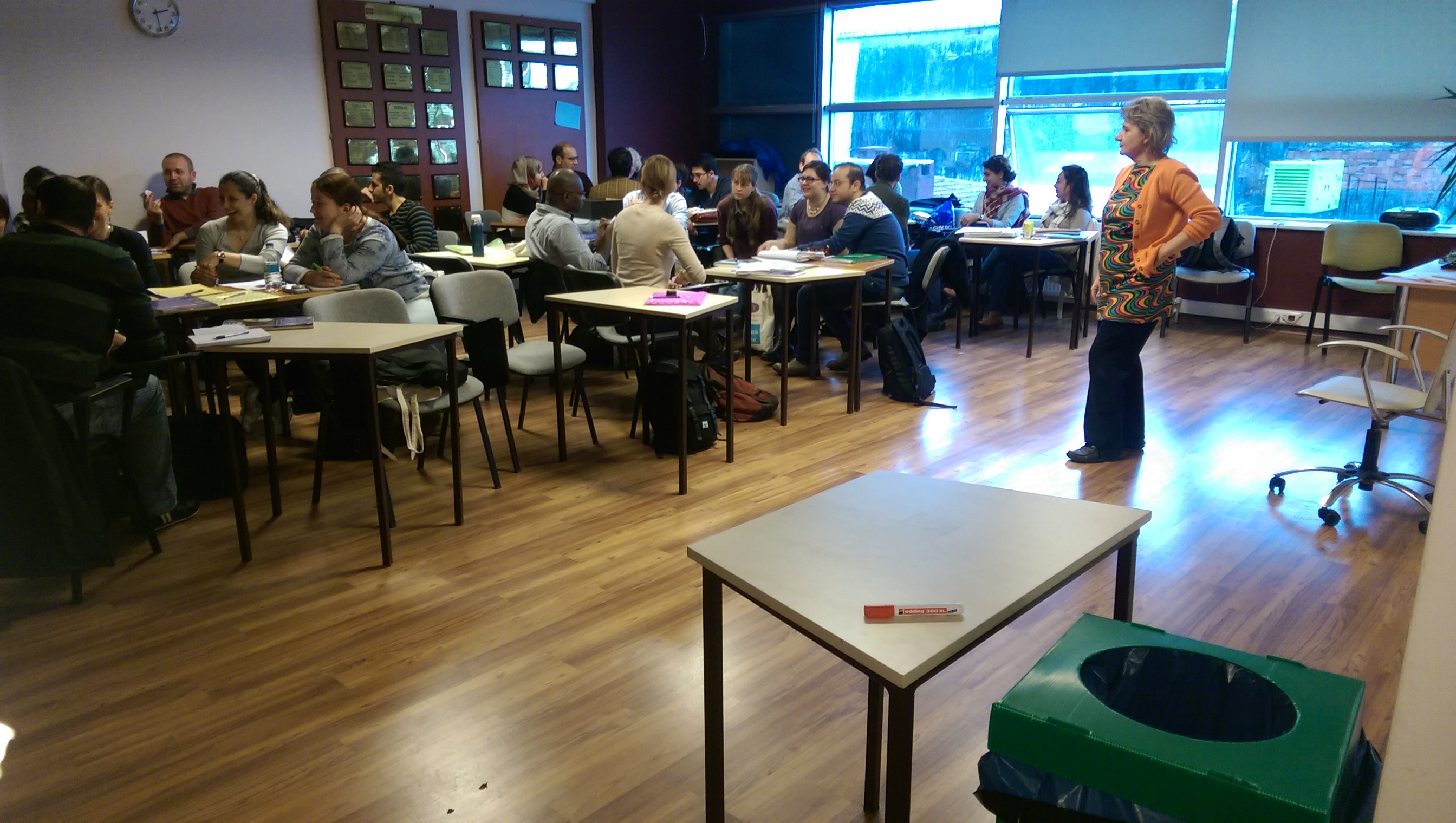
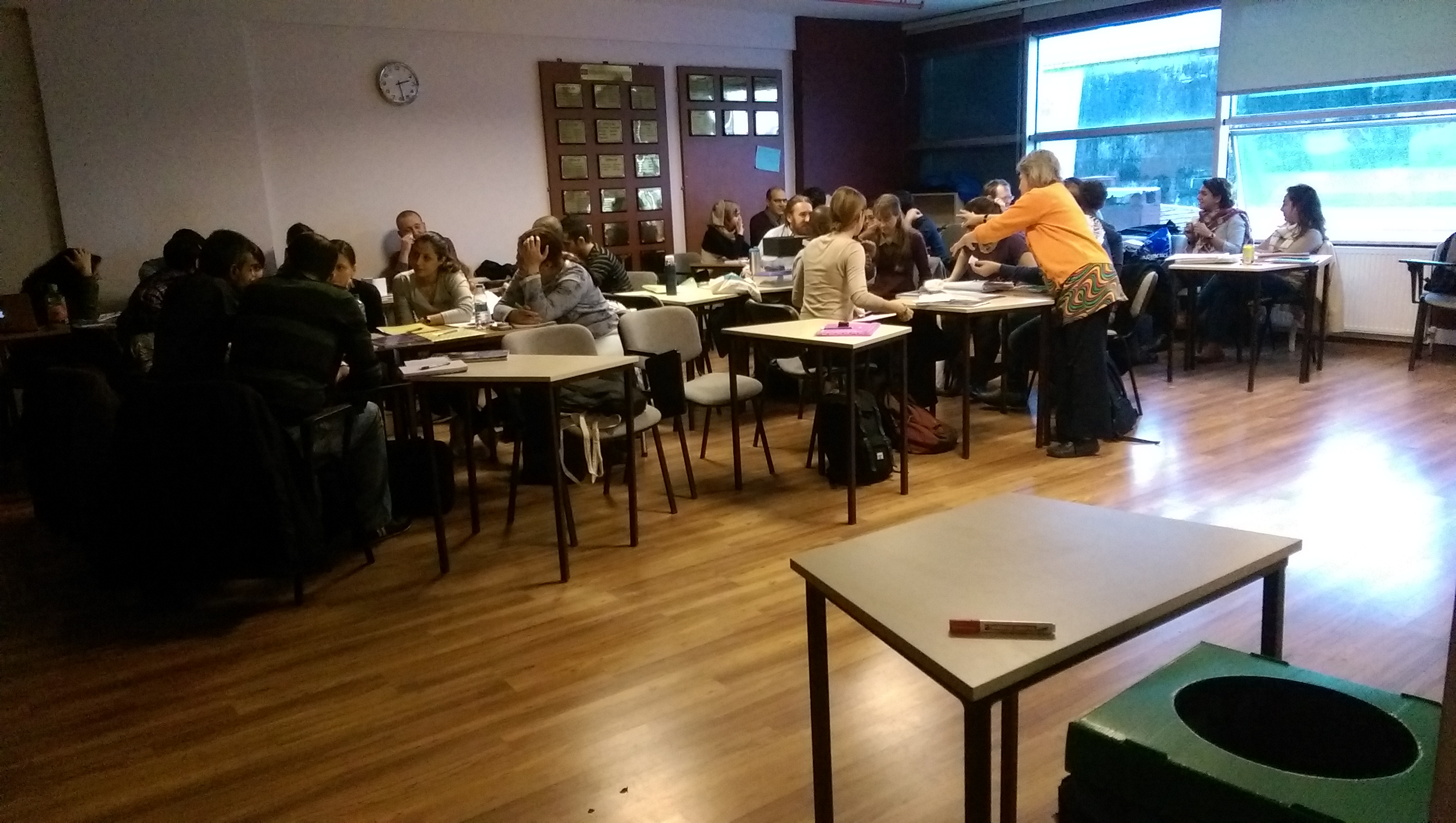
We are conducting a series of workshops to explore Applied Theatre and how these techniques and activities are relevant to Teacher Development.
In the workshops we experience and practice first-hand drama activities and develop skills that are used by Applied Theatre facilitators working in variuous fields of therapy and education.
We are exploring the questions:
To what extent can teaching be described as an art?
What sort of artistic training is required for successful practice?
How can Applied Theatre inform Teacher Development?
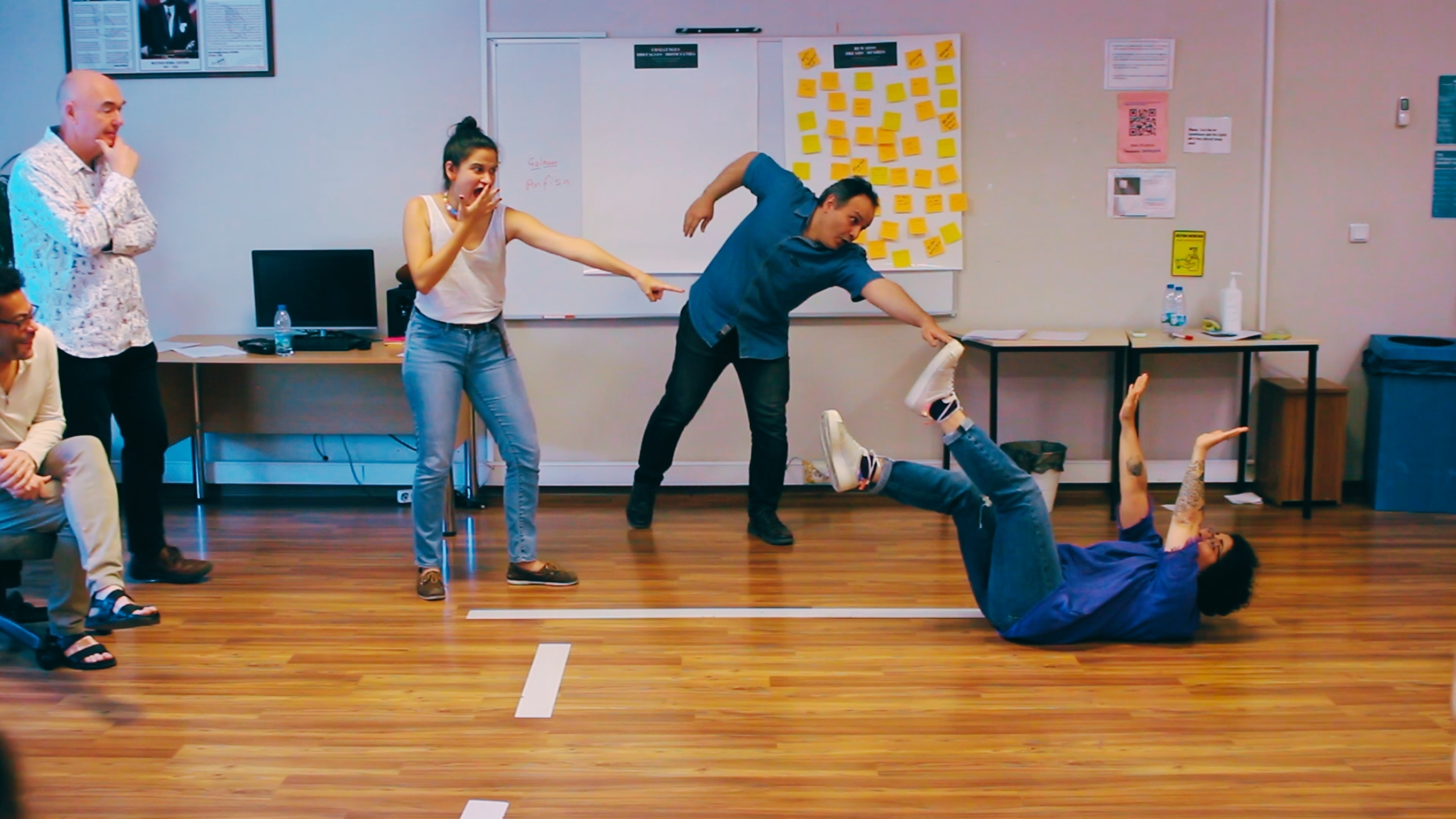
In the workshops we are creating a piece of drama that we will present to an audience at ITI on June 4th at 18.00. The drama will depict our interpretation of the challenges faced by a teacher and invite the audience to offer solutions.







 Teaching Artistry