
What is feedback?
John Hattie’s meta-study, “Visible Learning,” conducted in 2009, meticulously compiled various factors believed to impact student achievement. Not surprisingly, feedback emerged as a pivotal element, claiming the top spot among 138 identified factors. But what exactly do we mean by feedback? Why give feedback? Who should engage in it? How can it be done? And when should it be implemented?
Feedback, by its nature, offers insight into one’s performance, aiding in skill refinement and learning enhancement.
The essence of feedback lies in its ability to provide constructive insights into performance, enabling learners to identify areas for improvement and build upon strengths. In a classroom setting, feedback may encompass various forms, including ticks on a learner’s homework, comments highlighting strengths and weaknesses, grades, or simply eliciting correct answers.
Why give feedback?
There are three primary purposes:
The aim of feedback is not to do an activity that learners completed in pairs or groups again in open class with the teacher. This may be an obvious comment but there are many teachers who get into a habit of getting learners to do a task in pairs (such as a gap fill) and then doing the activity again in open class nominating learners to verbalise their answers.
In language classes, feedback takes various forms and serves multiple purposes:
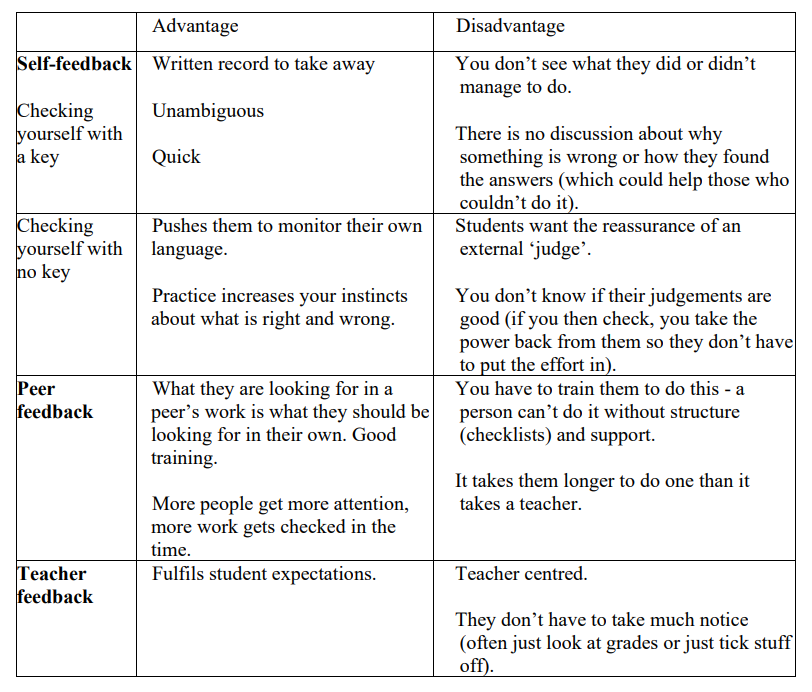
Who can / should give feedback? How?
1 Self -assessment: checking with answer keys, models
2 Peer feedback
3 Teacher feedback
Examples of feedback
One inventive feedback approach is the “board rush” method, particularly effective for activities with one-word answers or questions. In this competitive format, answers or questions are jumbled on the board, and learners, divided into teams, race to identify and circle the correct response upon seeing a related picture or prompt. This dynamic activity not only energizes the classroom but also reinforces learning outcomes through active engagement and friendly competition.
Alternative methods of giving feedback in interactive activities, where learners generate their own language, pose unique challenges. While tasks with single answers like gap fills or matching exercises lend themselves to straightforward feedback methods such as nomination or answer keys, interactive tasks require more nuanced approaches.
Peer correction and feedback become crucial in such scenarios, fostering collaboration and mutual support among learners. Encouraging learners to reflect on their own learning experiences adds depth to the feedback process, often revealing unexpected insights and areas of growth.
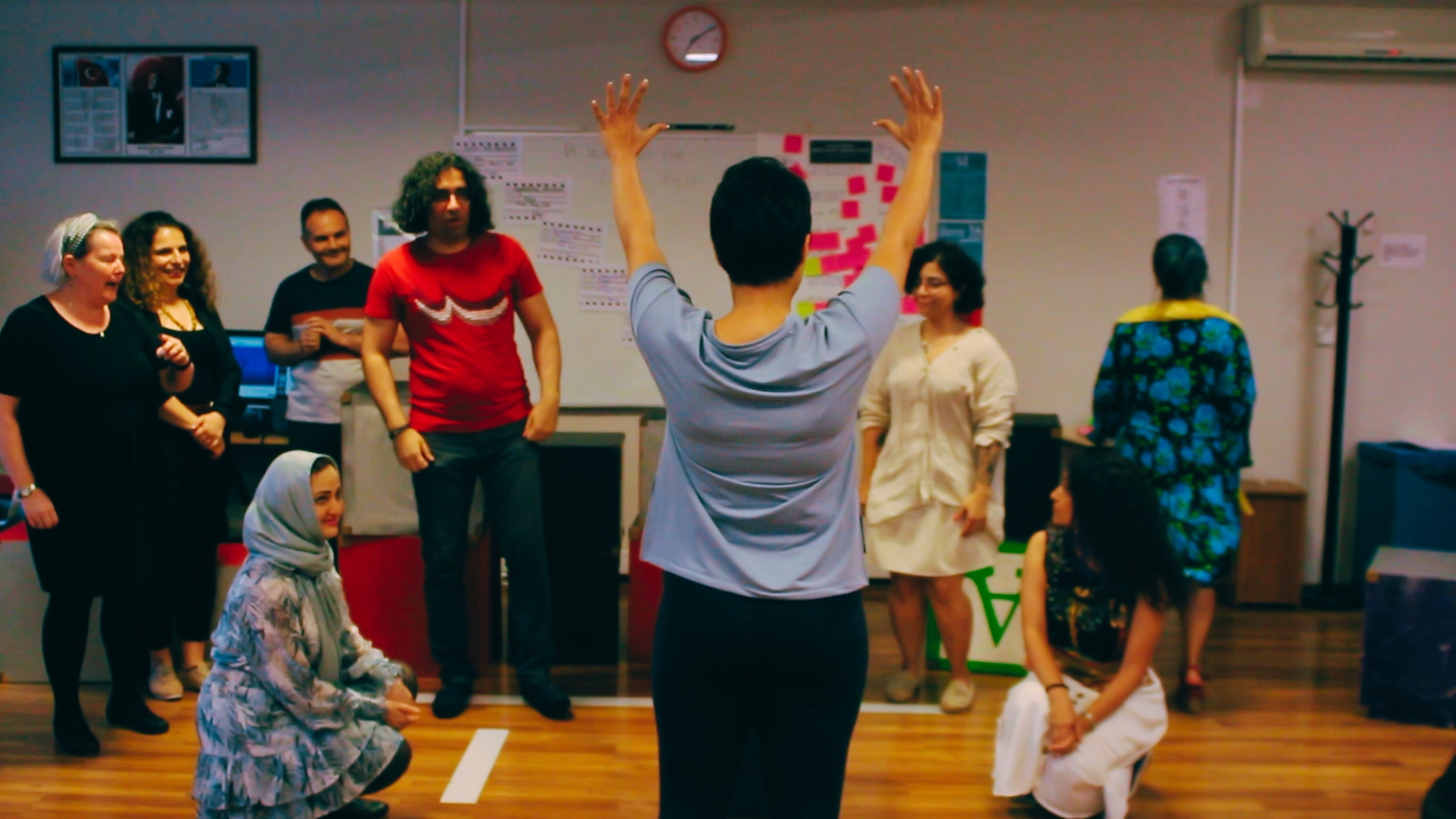
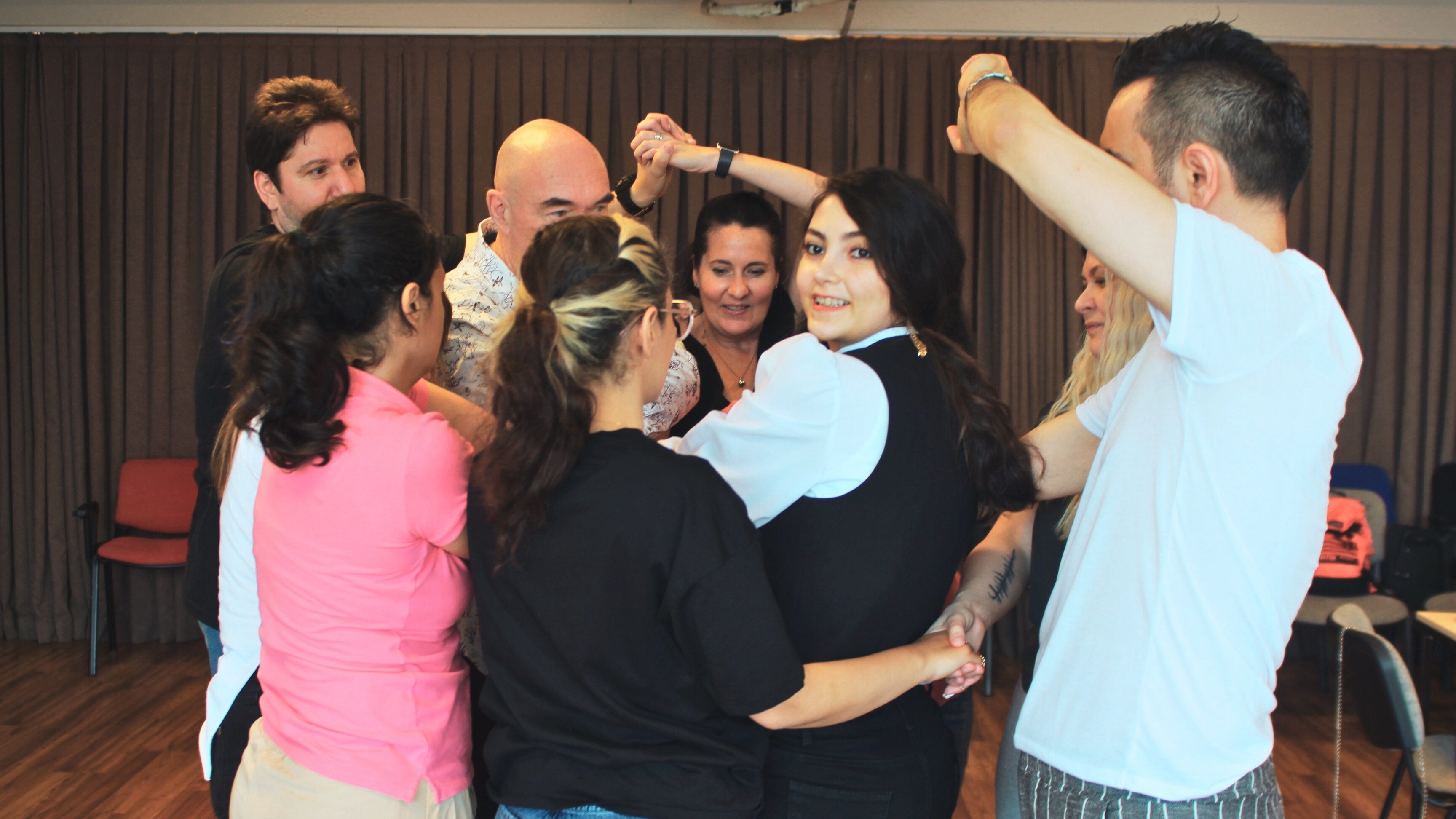
For those interested in honing facilitation skills and exploring performative methodologies, a facilitation skills master class workshop is offered annually. These workshops, held in July, delve into facilitation techniques and participatory methodologies, with a special focus on drama-based activities. Participants have the opportunity to engage in hands-on learning experiences and gain insights from experienced facilitators and peers.
To get a glimpse of the workshop’s content and participant experiences, video clips from previous sessions are available for viewing.
Whether you’re a seasoned educator or new to facilitation, these workshops provide valuable tools and strategies for creating engaging and effective learning environments. Mark your calendars and join us for an enriching learning experience this summer!Whether you’re a seasoned educator or new to facilitation, these workshops provide valuable tools and strategies for creating engaging and effective learning environments. Mark your calendars and join us for an enriching learning experience this summer!
Understanding communication is fundamental to facilitating effective interactions in any setting. Communication serves a purpose, often transactional in nature, where information is exchanged to achieve specific outcomes. This exchange relies on creating an information gap, where one party possesses information desired by another.
In educational contexts, activities that generate information gaps foster meaningful communication among learners. For instance, the “hot seat” activity involves one student facing away while another writes a word or phrase for them to guess through questioning. Similarly, “gallery reading” tasks students with gathering information from texts around the room to complete a task, promoting interaction and collaboration.
“Crossover groups” facilitate discussions or idea generation among distinct groups, who later share their findings with one another, creating multiple information gaps and encouraging communication. “Running dictation” requires pairs to collaborate in transferring text from a wall to paper, promoting active engagement and problem-solving.
In these activities, clear instructions and thoughtful consideration of space are essential to their success. Experience allows facilitators to anticipate and address potential challenges, ensuring smooth execution.
“Think pair share” is another common activity where learners contemplate a question individually before discussing it in pairs, encouraging active participation and collaboration. This activity can occur in open or closed settings, each offering distinct advantages and challenges.

In an “open classroom,” the teacher dominates interaction, while in a “closed pair” or “group,” all participants actively engage in conversation. Closed settings offer equal participation opportunities and reduced risk of embarrassment, fostering a supportive learning environment.
Activities like role plays and talking circles further enhance learner interaction and peer teaching. Role plays require preparation and allow learners to simulate real-life scenarios. In this example we have a beginners role play in a restaurant between a customer and waiter. You will notice the importance of the preparation stages. Firstly there is a gallery reading to get learners familiar with the vocabulary of the menu (food and drink), then there is input and controlled practice of the language and expressions needed in the role play, this is followed by open class demonstrations before the class is divided into closed pairs to perform their role plays.
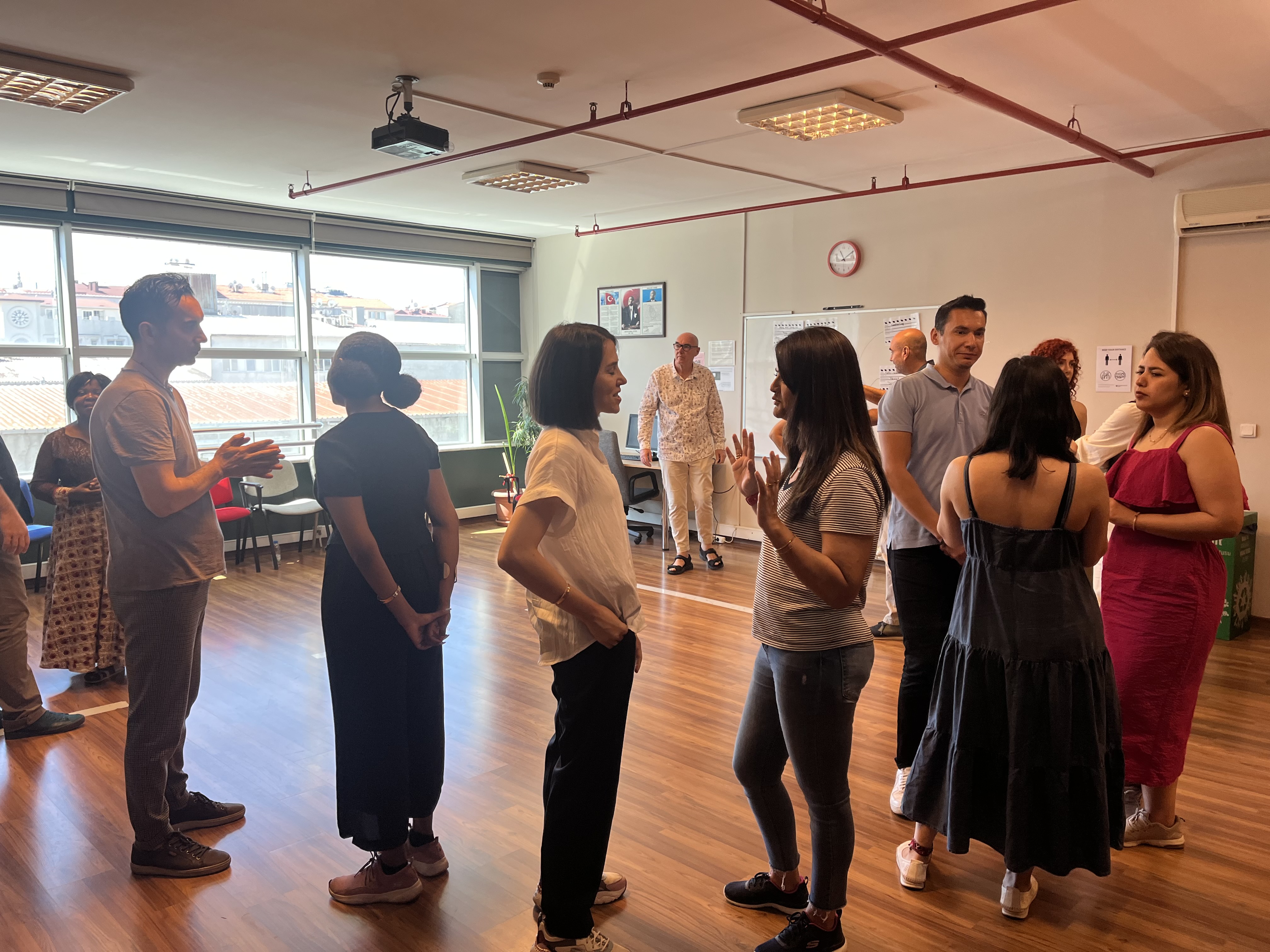
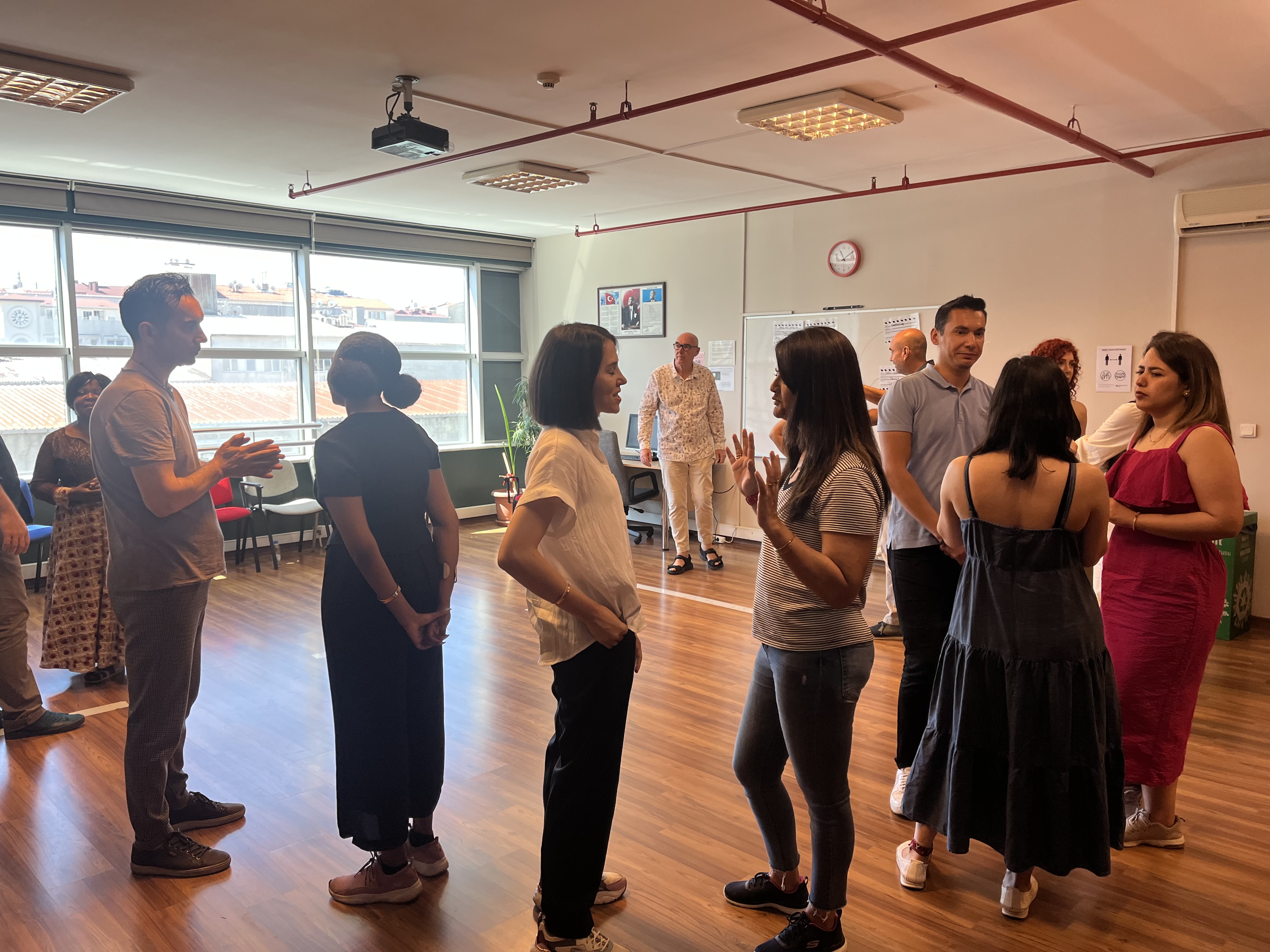
The ‘Talking circle’ activity facilitates dynamic interactive conversations among participants. Participants are arranged in two circles (an inner circle and an outer circle) facing each other. On a signal from the facilitator, the participants interact with the partner opposite them. After a period of time (usually only a few minutes to keep the dynamic and pace of the activity high), the facilitator gives the instruction to ‘stop and move’ and the outer circle move one step to their right so they are now facing a new partner. If this sounds complicated it can be done in two lines as in this video clip. Notive how in the video the facilitator is asking a lot of checking questions and using gestures. When setting up these kinds of activities, it is often more effective to show how to do the activity rather than tell (verbal instructions) as language learners typically follow the instructions with their eyes rather than their ears (especially at lower levels).
Personalized discussions, focusing on unique experiences or preferences, naturally generate information gaps and promote learner engagement. Structured discussions ensure that all participants have an opportunity to contribute and learn from one another’s experiences.
In sum, communication-driven activities play a vital role in facilitating interactions and fostering collaborative learning environments. By creating information gaps and promoting active participation, facilitators empower learners to engage meaningfully with course content and with one another.

Facilitation skills are vital tools in guiding groups through discussions, meetings, and learning processes to achieve specific goals. But before considering what these skills entail, let’s step back and consider the broader landscape of teaching and learning.
Teaching and learning encompass a spectrum of approaches and philosophies. At its core, teaching can be seen as both imparting knowledge to learners and guiding them in the process of learning itself. Similarly, learning involves not only acquiring information but also applying it actively. These perspectives reflect a fundamental epistemological distinction: positivism versus constructivism.

Positivists view knowledge as external and objective, something to be transmitted from teacher to student in a linear fashion. In contrast, constructivists see knowledge as constructed through social interaction and negotiation of meaning. This philosophical divergence profoundly influences teaching methodologies. Positivist educators may prioritize rote learning and information transmission, while constructivist educators emphasize inquiry, problem-solving, and collaborative learning experiences.
Within the realm of English as a Foreign Language (EFL) teaching, these philosophical orientations manifest in two distinct models: the competence model and the performance model. The competence model aligns with a positivist perspective, where teachers act as transmitters of information, and lessons are structured around predetermined aims and materials. In contrast, the performance model, rooted in constructivism, views teachers as facilitators of discovery, guiding learners through authentic, personalized learning experiences that prioritize language use and interaction.

Embracing the performance model necessitates honing facilitation skills to effectively guide learner interactions and foster meaningful learning experiences. Facilitation skills, fundamentally, are tools that promote interaction and collaboration in various social settings, whether in workshops, meetings, team-building exercises, educational contexts or even at home with the family.
Communication lies at the heart of facilitation skills, encompassing both verbal and non-verbal techniques to encourage participation and understanding among group members. Moreover, effective facilitation involves creating a positive learning environment where participants feel valued, empowered, and motivated to engage with one another towards shared objectives.
One strategy for cultivating a positive learning environment is through the use of icebreakers and warm-up activities. These activities, such as “find three things in common” or “find someone who,” not only help participants get acquainted but also set the tone for open communication and collaboration. Mingling activities, in particular, encourage active engagement and provide facilitators with valuable insights into participants’ strengths, interests, and levels of engagement.
The advantages of such activities are manifold. They promote confidence, relaxation, and language use, particularly in English language classrooms. They also facilitate rapport-building among participants and between participants and facilitators, laying the groundwork for productive collaboration. Additionally, these activities serve as energizers, fostering a dynamic and participatory learning atmosphere.
In essence, facilitation skills are essential for guiding groups towards collective goals, whether in educational, professional, or personal settings. By fostering effective communication, creating supportive environments, and employing engaging activities, facilitators empower participants to actively participate, collaborate, and learn together
Are you dreaming of making a significant impact in the world of English language education?
If so, you should consider joining ITI Istanbul on one of their premium teacher training courses.
Apply today, transform your aspirations into reality, and embark on a rewarding teaching career.
Click the link below to explore our courses:
If instead you’d like to speak to a member of our team, just call this number:
+90 212 283 64 66
Why?
Because ITI is one of the few centres globally specialising in courses accredited by the prestigious Cambridge University.
Whether you’re newly embarking on your teaching journey or are an experienced educator aiming to enhance your skills, ITI Istanbul offers the internationally recognised CELTA and DELTA courses, setting the gold standard in English language teaching.
At ITI, we believe in innovative teaching methodologies tailored to ensure an engaging and effective learning experience.
Our courses, including the use of drama and coaching, promise to guarantee personal and professional growth, opening doors to career opportunities worldwide.
Why Choose ITI?
– We are an Internationally Recognized Qualifications: Elevate your career with the CELTA and DELTA certifications.
– Flexible Learning Options: We offer both face-to-face and online courses to fit your unique circumstances, and serve the whole world.
– A Supportive Community: Join a network of like-minded professionals, forge lasting friendships, and receive dedicated expert instruction.
Don’t miss this life-changing opportunity.
Your future students are waiting for you to take this step.
In the era of dynamic digital connectivity, the call to revolutionize education grows louder. Traditional lecture-based approaches are seen to be failing today’s learners. Generation Z and Alpha crave interactive, participatory learning experiences. As we embrace this shift, it’s essential to equip educators with facilitation techniques to foster engaging, student-centered classrooms.
Why Facilitation?
Training Educators in Facilitation Techniques:
To support this transformative shift in education, educators must be equipped with facilitation skills. Introducing the ITI Master Facilitation Skills Weekend Workshop on July 27th/28th, 2024. This intensive training program offers educators the opportunity to:
Empower yourself to become a facilitator of change in education. Join us at the ITI Master Facilitation Skills Weekend Workshop and embark on a journey to transform teaching and learning for the 21st century.
Your future in education lies in developing effective facilitation skills.
Apply: https://www.iti-istanbul.com/other-training/drama-and-professional-development
Guba and Lincoln assertively propose that the fourth generation evaluation model addresses shortcomings inherent in the preceding three generations. They contend that the foundational principles of all previous evaluations are rooted in the positivist paradigm, which seeks a singular truth. According to them, this adherence to scientific methodology often results in overlooking contextual nuances and fails to embrace diverse perspectives and negotiation. Additionally, they argue that evaluation processes tend to prioritize the interests of the client, neglecting the plurality of values held by various stakeholders.
The fourth generation evaluation, in contrast, prioritizes responsiveness to stakeholders’ input. It embodies an ongoing, iterative process where evaluation findings continually inform and enhance the program in a formative manner. The primary objective of this evaluation approach is illumination—a deepened understanding and awareness among all stakeholders. Central to this process is a constructivist framework, which necessitates the active engagement and interaction of stakeholders’ viewpoints. Here, the notion of “truth” emerges through consensus among well-informed and diverse stakeholders. The criticism of the fourth generation evaluation is that despite the grand rhethoric of giving voice to all stakeholders, there are voices that are louder than others and often the more powerful, influential or higher status voices will hold sway. A related objection is that a consesus of opinion is not necessarily the most efficient in terms of programme evaluation and there is a case to argue that more experienced expertise should be given more weight.
In summary, the fourth generation evaluation model represents a departure from traditional, top-down evaluation approaches. Instead, it emphasizes collaboration, dialogue, and continuous improvement, guided by a constructivist philosophy that acknowledges the complexity and diversity of perspectives within educational contexts.
The third generation of evaluation represents a synthesis of the previous two approaches (goal-driven product approach and rich description process approach. Here, evaluation serves as a tool for assessing the extent to which curriculum innovations are implemented in practice, emphasizing the distinction between evaluation processes and outcomes. This perspective views evaluation not merely as a measurement of goal achievement but also as a process that can be both formative and summative. In essence, by focusing on decision-making processes, evaluation generates data that informs future planning and decision-making endeavors.
One significant aspect of this generation of evaluation is its increasing emphasis on compliance with mandates. Many educational programs, while administered locally, require accreditation from external bodies, necessitating adherence to both internal and external quality assurance standards (such as those governing training courses like CELTA). However, this focus on compliance often leads to a disproportionate amount of time being spent on bureaucratic tasks rather than on actual teaching or teacher education. Consequently, there is a growing tendency for professionals to prioritize documenting compliance as a valuable skill, potentially overshadowing other aspects of their roles.
Moreover, there is a risk that adherence to mandates may become conflated with good practice, resulting in a situation where trainers make fewer professional decisions and perceive their primary task as simply complying with regulations. This can stifle innovation and limit the ability to address longstanding design issues within educational programs. Thus, while the third generation of evaluation aims to incorporate aspects of both process and outcome assessment, its emphasis on compliance underscores the need for a balanced approach that does not compromise the core objectives of education and professional development.
Our first post focused on the goal-driven approach to evaluation and pointed out that while such methods excel at quantifying and measuring achievement, they often fall short in explaining the underlying dynamics of educational processes.
An alternative to focusing on how effectively the programme meets its goals is to focus on describing the processes used to meet them. To go back to the analogy of the archer: While a goal driven approach would measure how close the arrow is to the target, a process approach would describe the process – who the archer is, what he does, the weather conditions, the environment and so on. The method is grounded on the premise that stories prove far more convincing than pages of numbers. Qualitative accounts can provide rich descriptions and explanations of processes helping evaluators go beyond preconceptions and frameworks. The extreme version of this approach is the ‘goal-free evaluation’ in which the evaluator pays no attention to stated goals but instead examines what is actually happening, arguing that if the goals are relevant, they will show up.
Critics of ethnographic evaluation models, that rely on thick descriptions, is that apart from being time consuming, they avoid judgements and therefore although rich in content the information is difficult to decipher for decision makers and policy analysts. While the first generation evaluation methods attempt to form judgements of effectiveness, the second generation methodology aims at greater depth of understanding of what is happening.
In summary, the second generation of evaluation shifts the focus from assessing outcomes to understanding the intricate workings and dynamics of the processes involved in achieving those outcomes. This approach acknowledges the complexity of educational systems and aims to provide nuanced insights. However, as all stories can be interpreted in multiple ways, the approach may lack directness in informing decision-making and policy development.
Assessing the effectiveness of educational programs is a complex and elusive task. As a Teacher Educator I have considered many ways to answer the question: How effective are our courses? In this four-part series I am going to explore the evolution of educational evaluation. Understanding this evolution involves exploring various perspectives that have shaped evaluation practices within the broader context of education. Key distinctions emerge between quantitative and qualitative approaches, democratic and non-democratic processes, as well as scientific and naturalistic methodologies. Additionally, evaluations can be oriented towards action or understanding. This historical trajectory reveals four distinct generations of evaluation.
1st Generation: The Product Approach
If we wanted to measure how effective archers are at shooting an arrow, we would measure the distance from the arrow to its intended target. This is essentially the basic premise behind a product (or goal driven) approach to evaluation, comparing intended outcomes ‘goals’ with actual outcomes: this simple logic has had a tremendous influence on educational and curriculum evaluation.
This approach historically aligns evaluation with the scientific, or positivist paradigm, particularly in measuring the effectiveness of educational curricula in achieving stated objectives. Many evaluation studies in English Language Teaching (ELT) over recent decades have adhered to this goal-driven approach. The current emphasis on identifying teacher competencies and measuring development based on a range of skills, abilities, and knowledge represents an evolution of this approach. Typically conducted by external evaluators according to predefined criteria, these studies primarily aim at ensuring accountability.
However, a significant limitation of the goal-driven approach is its inability to provide insights into the reasons behind the outcomes. If we go back to our archer’s analogy, supposing all the arrows missed their target. Well, we would know that the archers were not meeting their goals but not why. Similarly, if all the arrows were hitting the bull’s eye does this mean the archers are exceptional or that the target should be set at a more ambitious distance further away. In other words, there could be a strong temptation to make the targets more achievable than to improve overall programme effectiveness.
Critics of the product approach to evaluation argue that in the realm of education, the focus should be on people rather than parameters. While positivist methods excel at quantifying and measuring achievement, they often fall short in explaining the underlying dynamics of educational processes. In short, the product approach fails to provide a holistic understanding of educational practices.