What Are You Chasing?

The Game of Tag That Becomes a Mirror for Teachers

How a simple running game exposes burnout, ambition, and the hidden pressures shaping your teaching.

In my Teaching Artistry workshops, I sometimes begin with a game.

A running game.

Arms linked.
Laughter.
Energy rising.

It looks like something from a primary school playground.

It isn’t.

Within minutes, it becomes a metaphor for life, leadership, and why we became teachers in the first place.


The Game: Cat and Mouse

Participants link arms in pairs, forming a human chain.

One person is the cat (the chaser).
One person is the mouse (the chased).

The cat runs.
The mouse escapes.

The mouse is safe if they hook onto a linked pair.
That releases someone else — who instantly becomes the new mouse.

Chaos.
Speed.
Laughter.
Adrenaline.

And then the shift.


The Question That Changes Everything

After 10–15 minutes, breathless and smiling, I ask:

  • How did it feel to be chased?
  • How did it feel to chase?
  • Which role did you prefer?
  • What thoughts ran through your head?

Then the deeper question:

In your life, are you chasing — or being chased?

The room gets quieter.

Because suddenly it’s not a game anymore.


What It Reveals

This simple activity surfaces powerful dynamics:

  • urgency
  • fear
  • competitiveness
  • avoidance
  • collaboration
  • reliance on others

Some teachers love the thrill of chasing.

Others feel uncomfortable being pursued.

Some desperately look for safety.
Some hesitate to join a pair.

It becomes a live metaphor for:

  • ambition
  • burnout
  • purpose
  • escape
  • belonging

What are you running towards?
What are you running away from?

And how does that relate to why you’re here?


Variations That Deepen the Mirror

We sometimes play Stuck in the Mud.

When tagged, you freeze — legs apart — until someone crawls through to free you.

Suddenly the focus shifts:

Who helps?
Who notices?
Who leaves others stuck?

Or Linked Arms Tag.

When tagged, you link arms with “it.”

The chain grows.

Eventually, everyone is connected.

It stops being about speed.

It becomes about unity.


Why This Matters for Teachers

These are not icebreakers.

They are diagnostics.

They reveal:

  • how we relate to pressure
  • how we respond to being pursued
  • how we support others
  • how we seek safety
  • how we experience competition

Teaching is often described as intellectual work.

But it’s also embodied.

We chase targets.
We feel chased by deadlines.
We look for safety in institutions.
We link arms with colleagues — or we don’t.

Sometimes it takes a “children’s game” to surface what we’re really feeling.


This Is the Kind of Work We Explore

In the Performative ELT community, we explore activities like this — not as entertainment, but as reflection.

We ask:

What does this reveal about who I am as a teacher?
What patterns am I repeating?
Where am I running — and why?

If you’re interested in embodied, experiential approaches to teacher development — the kind that go beyond methodology and into identity — you’re warmly invited to join us.

It’s free.

👉 https://performativeelt.com/free-community-6779

Because sometimes the most important professional question isn’t:

“What should I teach next?”

It’s:

What am I chasing?
Posted in Teacher Development | Tagged , , , , , , , , , | Leave a comment

Hypnosis And The Exercise That Reveals How You Handle Control

Columbian Hypnosis

(And Why Every Teacher Should Try It)

In my Teaching Artistry workshops, I sometimes tell teachers:

“You’re about to hypnotise each other.”

There’s always a pause.

Then laughter.

Then curiosity.

The activity is called Colombian Hypnosis, developed by Augusto Boal in Games for Actors and Non-Actors.

And in under 10 minutes, it reveals more about trust, control, and teacher identity than many theoretical discussions ever could. Watch a demo here:


What Happens

One participant holds their hand 20–40 cm from their partner’s face.

Palm forward. Fingers upright.

The partner must keep their face the same distance from the hand at all times.

Where the hand moves, the face follows.

Up. Down. Sideways. Diagonal. Slow spirals. Sudden shifts.

The leader must never stop completely.
The follower must never lose alignment.

Very quickly:

  • bodies bend into unusual shapes
  • forgotten muscles wake up
  • laughter mixes with discomfort
  • concentration sharpens

Then they switch.

Leader becomes follower.

Control becomes surrender.

Later, both extend a hand at the same time — becoming leader and follower simultaneously.

And that’s where it gets interesting.


What It’s Really About

On the surface, it’s a movement exercise.

In reality, it’s about:

  • focus and presence
  • spatial awareness
  • non-verbal communication
  • empathy
  • responsibility
  • power

It exposes how we relate to control.

Some participants love leading.

Others feel anxious holding responsibility for someone else’s body.

Some relax when following.

Others resist being directed.

In a few minutes, patterns emerge.


The Questions That Matter

After the movement, I don’t analyse technique.

I ask:

  • Which did you prefer — leading or being led?
  • Why?
  • Was it easy to trust your partner?
  • What helped it work well?
  • What made it difficult?

And then the deeper question:

How does this relate to how we teach?

Because teaching is a constant negotiation of:

  • authority and agency
  • guidance and autonomy
  • control and trust

In classrooms, we lead.
We invite.
We structure.
We respond.

But do we always notice how much control we hold?

Or how much we struggle to release it?


Why This Matters for Teachers

Colombian Hypnosis is not about theatre.

It’s about awareness.

It surfaces:

  • our instinct to dominate or withdraw
  • our comfort with vulnerability
  • our ability to read others non-verbally
  • our tolerance for uncertainty

And it reminds us that facilitation is embodied.

Before it’s a strategy, it’s a stance.

Before it’s a method, it’s a relationship.


This Is the Kind of Work We Explore

Activities like this aren’t icebreakers.

They’re mirrors.

They help teachers reflect on presence, power, empathy, and responsibility — through experience, not lecture.

If this kind of embodied exploration resonates, you’re warmly invited to join our free Performative ELT community.

It’s a space where we share practical activities like this, unpack the theory behind them, and explore what it really means to teach with presence and artistry.

You can join us here:

👉 https://performativeelt.com/free-community-6779

Because sometimes the most important professional question isn’t:

“What method should I use?”

It’s:

When do I lead — and when do I let go?

Posted in Teacher Development | Tagged , , , , , , , , , | Leave a comment

Unlocking Teacher Potential: The Owl Transformation

The Owl Transformation

The 10-Minute Activity That Reveals More About Teaching Than a Lecture Ever Could

I often begin my Teaching Artistry workshops with a warning:

“This activity is dangerous.”

Teachers look concerned.

Then I tell them they’re going to transform.

Not sentences.
Not active to passive.
Not direct to reported speech.

Themselves.

Into an owl.

And that’s when the discomfort begins.


Why Ask Adults to Become Owls?

On the surface, it’s a simple concentration and voice exercise (inspired by work from Alan Maley).

But in reality, it’s something much deeper.

The Owl Transformation develops:

  • focus and presence
  • vocal strength
  • spatial awareness
  • group rapport
  • empathy and sensitivity
  • imaginative flexibility

And, perhaps most importantly, it exposes how easily adults lose access to play.


The Setup

Participants stand in a circle.

I describe the owl:

A bird that comes out at night.
Large eyes.
Wise.
Able to turn its head almost all the way around.

Then I say:

“Transformation is straightforward.
The danger comes when transforming back.”

That line always sharpens concentration.


The Transformation

  • Shake your wings (arms).
  • Close the windows (so no one flies off).
  • Place your right hand on your left shoulder.
  • Turn your head to look behind you.
  • Take a deep breath.
  • On “Go”, return slowly to centre.
  • Wide eyes.
  • A strong, focused owl hoot.

There is almost always nervous laughter.

I gently remind them:

“Owls do not laugh.”

We try again.

Concentration deepens.

The room changes.


The Real Work Begins After the Hoot

The transformation isn’t the point.

The reflection is.

I ask:

  • How did you feel?
  • Self-conscious? Resistant? Silly?
  • Did you laugh—or manage to stay focused?
  • What thoughts did you use to control the impulse to laugh?

Something powerful happens here.

Teachers begin to notice their internal dialogue.

Their self-talk.
Their resistance.
Their vulnerability.

And then we ask the bigger question:

Why does something that comes so naturally to children feel uncomfortable for adults?

Children transform constantly.
Soldier. Train driver. Witch. Frog. Princess.

No embarrassment. No irony. No apology.

So what changed?


What This Activity Really Teaches

The Owl Transformation is not about drama.

It’s about:

  • reclaiming imagination
  • managing self-consciousness
  • intervening in unhelpful self-talk
  • strengthening presence under pressure

It reveals how creativity requires concentration, not confidence.

And how professional growth often involves stepping through mild discomfort.

In many ways, this 10-minute exercise says more about teaching identity than a two-hour lecture on methodology.


Why This Matters for Teachers

In classrooms, we constantly ask learners to:

  • take risks
  • speak imperfectly
  • perform in front of others
  • suspend disbelief
  • imagine

If we cannot tolerate mild vulnerability ourselves, what message are we sending?

The Owl Transformation surfaces this tension gently, playfully, safely.

And that’s the power of performative pedagogy.


This Is the Kind of Work We Explore

Activities like this are not icebreakers.

They are diagnostic.

They reveal beliefs, habits, and hidden narratives about creativity and professionalism.

If this resonates, you’re warmly invited to join our free Performative ELT community.

It’s a space where teachers explore:

  • embodied approaches to teaching
  • facilitation as presence
  • imagination in professional identity
  • practical activities like this one (with reflection and theory behind them)

You can join us here:

👉 https://performativeelt.com/free-community-6779

Because sometimes, the path to becoming a more present, confident facilitator begins with one simple question:

Can you become an owl without laughing?

Posted in Teacher Development | Tagged , , , , , , , , , , , | Leave a comment

Every Time You Give Feedback, You Choose Control or Trust

Feedback Isn’t Neutral: What Every Facilitator Is Really Choosing

Feedback feels like the responsible thing to do.

Learners expect it.
Institutions demand it.
Teachers are trained to provide it.

But feedback is never just feedback.

Every time a facilitator responds to learner work, they are making a deeper decision—often without realising it.

A decision about control, trust, and whose voice matters.


Before “how”, there’s a more important question

Before deciding how to give feedback, facilitators need to pause and ask:

What is this feedback actually for?

Common purposes include:

  • improving accuracy
  • helping learners notice gaps
  • encouraging reflection
  • building independence
  • meeting learner expectations

None of these are wrong.

Problems arise when these purposes conflict—or when they remain unexamined.


The trade-offs we don’t talk about

Teacher feedback offers real advantages:

  • clarity
  • efficiency
  • reassurance

But it also comes with costs:

  • learners may become dependent
  • attention narrows to correctness
  • learners slip into passive roles

Facilitation doesn’t reject teacher feedback.

It treats it as powerful—and therefore dangerous if overused.


Why peer feedback so often fails

Peer feedback is frequently described as “learner-centred”.

In practice, when it’s poorly facilitated, it can:

  • feel superficial
  • create discomfort
  • spread misinformation

The issue isn’t peer feedback.

It’s the assumption that learners already know how to do it.

Effective peer feedback requires:

  • clear criteria or guiding questions
  • modelling by the facilitator
  • a psychologically safe climate
  • explicit training and repeated practice

Peer feedback isn’t a shortcut.

It’s a skill learners must learn.


The real tension beneath feedback

At its core, feedback forces facilitators to negotiate a deeper tension:

  • control vs trust
  • certainty vs emergence
  • authority vs agency

Every feedback choice answers the question:

Do I step in—or do I step back?

Facilitation lives in this tension.


Feedback is not a technique. It’s a judgment.

There is no universally “best” feedback approach.

Facilitation involves:

  • reading the group
  • sensing the moment
  • choosing the response that best supports learning now

This judgment can’t be scripted.

It develops through:

  • reflection
  • experimentation
  • discomfort
  • self-awareness

When feedback builds community

Well-facilitated feedback does more than improve performance.

It:

  • normalises imperfection
  • values process as much as product
  • strengthens collective responsibility

It communicates not just what matters—but how we learn together.


By the time feedback happens, it’s already too late

By the moment feedback is given, facilitation has already shaped:

  • who spoke
  • how safe it felt to speak
  • how learning is interpreted

Feedback doesn’t stand alone.

It completes a facilitation arc that began long before anyone spoke.


A final reflection

  • Where do you feel the strongest pull between control and trust?
  • Which feedback habits feel hardest to let go of?
  • What kind of facilitator are your feedback choices shaping you into?

Facilitation is never finished.

It’s refined through noticing, reflecting, experimenting—and listening, not only to learners, but to oneself.

The most effective facilitators aren’t those with the most techniques.

They’re the ones with the clearest judgment and deepest presence.

Posted in Teacher Development | Tagged , , , , , , , , , , , , , | Leave a comment

What You Do While Learners Are Talking Matters More Than What You Say

What Do You Do While Learners Are Talking?

The hidden craft of facilitating discussion

Facilitation doesn’t reveal itself in the lesson plan.

It reveals itself after the activity has started.

Once learners begin speaking freely—really speaking—the facilitator faces a very different challenge:

What do I do now?
Do I step in?
Do I correct?
Do I wait?

This is the moment where facilitation stops being theoretical and becomes visible.


Discussion is not a task. It’s an event.

Free discussion is unpredictable by nature.
Once learners start talking, outcomes can’t be fully planned or controlled.

From a facilitation perspective, discussion is:

  • emergent, not scripted
  • social, not individual
  • shaped moment by moment, not line by line

This unpredictability is exactly what makes discussion pedagogically powerful.

And exactly what makes it uncomfortable.


The hardest facilitation skill? Doing nothing.

During discussion, many facilitators feel an almost physical urge to intervene.

To:

  • correct language immediately
  • redirect ideas
  • summarise too early
  • fill silence

But effective facilitation doesn’t start with speaking.

It starts with watching.

Skilled facilitators attend to:

  • who is speaking—and who isn’t
  • how turns are taken
  • shifts in energy and engagement
  • moments of hesitation, excitement, or withdrawal

This observational stance isn’t passive.
It’s what makes principled feedback possible later.


The real question isn’t “Can I give feedback?”

It’s:

Why would I give feedback now?

After free discussion, feedback can serve many purposes:

  • helping learners notice effective communication
  • reinforcing confidence and risk-taking
  • drawing attention to interaction strategies
  • addressing patterns that genuinely matter

Facilitation is the art of choice.
Not everything you notice needs to be said.


Feedback should continue the discussion—not end it

Poorly handled feedback can:

  • shut down participation
  • recentre the teacher
  • turn discussion into evaluation

Well-facilitated feedback does the opposite. It:

  • extends learning
  • keeps learner voice central
  • validates participation rather than punishing it

One powerful move is to begin with learners’ perceptions:

  • What did you notice about the discussion?
  • What helped it keep going?
  • Where did communication break down?

Now feedback becomes shared inquiry, not judgement.


Five lenses facilitators can choose from

Feedback doesn’t have to mean “language correction”.

It can focus on different lenses:

  • Content – ideas, opinions, experiences
  • Interaction – turn-taking, listening, responding
  • Language – accuracy, range, pronunciation
  • Strategy – how learners managed the discussion
  • Affective factors – confidence, engagement, risk

The facilitation question is always the same:

Which lens best serves learning right now?


Why over-feedback kills discussion

One of the most common facilitation mistakes is saying too much.

When everything is commented on:

  • learners struggle to prioritise
  • confidence drops
  • discussion becomes performative rather than exploratory

Selective feedback isn’t withholding.

It’s protective.


Why this matters more than we admit

Discussion is one of the few classroom moments where:

  • learners experience real agency
  • meaning is negotiated socially
  • learning feels alive

How facilitators respond afterwards determines whether learners experience discussion as:

  • a space for growth
  • or a space for exposure

That difference shapes participation far beyond a single lesson.


A final reflection for facilitators

  • What do you notice first during discussion?
  • What do you feel compelled to comment on—and why?
  • How might selective feedback support confidence rather than control?
  • What would change if feedback were treated as part of the discussion itself?

Facilitation isn’t about saying the right thing.

Sometimes, it’s about knowing when not to speak.

Posted in Teacher Development | Tagged , , , , , , , | Leave a comment

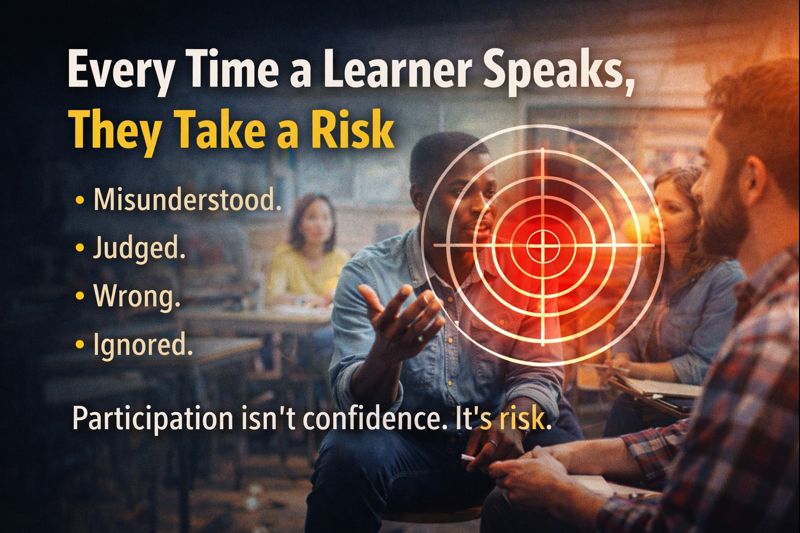
Every Time a Learner Speaks, They Take a Risk

Participation isn’t about confidence or motivation.
It’s about how much risk the learning space asks learners to carry.

Participation Isn’t About Confidence.
It’s About Risk.

Facilitation isn’t just about getting more people to speak.
It’s about how much risk speaking feels like.

Every time a learner contributes, they risk being:
misunderstood, judged, wrong, or ignored.

How we structure interaction determines whether that risk feels manageable — or overwhelming.


Participation always carries risk

Speaking in a learning space is never neutral.
It involves:

  • social exposure
  • cognitive effort
  • emotional vulnerability

Some learners find this energising.
Others find it threatening.

Facilitators can’t remove risk — but they can shape how it’s experienced.


Think–Pair–Share isn’t a technique. It’s risk management.

Think–Pair–Share works because it sequences visibility:

  • Think → private processing
  • Pair → rehearsal and support
  • Share → public contribution

Seen this way, it’s not a discussion activity.
It’s a way of protecting learners before asking them to be visible.

When sequencing is skipped:

  • confident voices dominate
  • hesitant learners withdraw
  • silence becomes uncomfortable

Sequencing widens access to voice without forcing it.


Open vs closed interaction (and why both matter)

Open interaction

  • spontaneous
  • unpredictable
  • high ownership
  • high risk

Closed interaction

  • guided turns
  • clearer expectations
  • lower risk
  • less spontaneity

Neither is “better”.

Facilitation is about asking:
Which structure serves this group, right now, for this purpose?

Skilled facilitators move between them — they don’t default.


Role play: powerful, risky, misunderstood

Role play can:

  • increase authenticity
  • allow experimentation with identity
  • shift risk from self to role

But without careful facilitation, it can feel exposing or threatening.

What makes the difference?

  • clear framing
  • optional participation routes
  • preparation time
  • reflective debriefing

Structure turns risk into play.


Talking Circles: redistributing voice

Talking Circles deliberately slow interaction and equalise speaking rights.

They:

  • protect quieter voices
  • foreground listening
  • reduce dominance

But only when silence is respected and participation isn’t coerced.

Equality of voice has to be held, not enforced.


This is an ethical issue, not a technical one

When we structure interaction, we decide:

  • whose risks are supported
  • whose voices are heard
  • whose silence is respected

Too much safety leads to passivity.
Too much risk leads to withdrawal.

Facilitation lives in the tension between the two.


A question to take into your next lesson 👇
Are you inviting participation — or managing risk?

(Adapted from Chapter 5 of my Facilitation Skills handbook.)

Posted in Teacher Development | Tagged , , , , , , , , , | Leave a comment

The Importance of First Impressions in Facilitation

The First Five Minutes Matter More Than You Think

The first five minutes of a lesson, workshop, or course often do more pedagogical work than the next fifty.

Before learners engage with content or objectives, they encounter something more immediate:

the climate of the space.

This chapter of my Facilitation Skills handbook explores a simple but often overlooked idea:
facilitation begins before teaching.


Beginnings are not neutral

Ice breakers and warmers are often treated as optional extras — something to “get things going.”

From a facilitation perspective, this underestimates their power.

Beginnings quietly:

  • establish norms for participation
  • signal who is expected to speak
  • shape perceptions of safety and risk
  • influence who contributes later — and who stays silent

Facilitation starts the moment people enter the room.


Ice breakers aren’t about fun — they’re about positioning

Good ice breakers don’t entertain.
They position learners.

They position:

  • learners in relation to each other
  • learners in relation to the facilitator
  • learners in relation to voice and risk

Take a simple activity like Find Someone Who.
On the surface, it looks light and social.
Underneath, it:

  • invites personal disclosure without overexposure
  • equalises participation
  • creates immediate peer connection
  • shifts attention away from the teacher

That’s facilitation at work.


When ice breakers go wrong

Ice breakers usually fail not because learners are resistant, but because:

  • too much disclosure is demanded too soon
  • the purpose is unclear
  • the process is rushed
  • participation becomes uneven or exposed

Poorly facilitated openings can increase anxiety and reinforce silence.

Facilitation isn’t about doing an activity.
It’s about holding a process.


Warmers ≠ Ice breakers

Although we often use the terms interchangeably, facilitation benefits from distinguishing them.

  • Ice breakers build safety, trust, and connection
  • Warmers build energy, focus, and readiness

An energetic warmer without safety can still exclude.
A safe ice breaker without momentum can stall.

Skilled facilitators choose intentionally.


“Getting to know you” is pedagogical

Opening activities don’t just build rapport — they provide vital information.

They show us:

  • who speaks easily
  • who hesitates
  • who dominates
  • who withdraws

This is diagnostic data.
And it should shape how we facilitate everything that follows.


Presence at the beginning

Facilitation at the start of a session requires:

  • attentiveness
  • restraint
  • responsiveness

The facilitator’s job isn’t to perform confidence, but to contain uncertainty — both theirs and the group’s.

That’s why beginnings feel risky.
They reveal dynamics before control is established.


Why this matters later

The climate created at the beginning affects:

  • participation in discussion
  • willingness to give peer feedback
  • tolerance of ambiguity
  • how silence is experienced

Facilitation is cumulative.
What happens later depends on what was made possible earlier.


Reflection 👇
What do your lesson openings communicate — not about content, but about participation?

Posted in Teacher Development, Uncategorized | Tagged , , , , , , , , , | Leave a comment

Warmers and Ice Breakers

A mingling activity like ‘find someone who’ is an example of an effective warmer activity. And basically there are three stages. There’s the setting up stage where the instructions need to be clear. And you notice that the facilitator was eliciting the instructions and providing examples at each stage. Then there is the task itself where the people stand up and mill around asking each other questions and interacting. And then there is the feedback stage where the facilitator asks for reporting back on what was discovered. So I think the advantages of these kind of activities is that it helps participants gain confidence. They feel relaxed. They start interacting, they start speaking in English, if it’s a language classroom, but even if it’s a training session or a meeting, it gets them going, it sort of activates them.

It gives the facilitator or trainer an opportunity to diagnose the participants, see who they are, what do they know, what are their attitudes. If it’s a classroom, their level of English. it also gets participants to get to know each other as well as the trainer or facilitator. It’s a process of beginning to build a rapport and beginning to encourage self-disclosure. It sets the atmosphere for the course. It kind of says, okay, this is the way we’re going to interact. This is the way the learning is going to happen. And it’s an energizer. It gets people active and participating.

Posted in Uncategorized | Leave a comment

What Do We Really Remember About Teaching?

Researching the Performative

I would like to invite you to join an ongoing practitioner-led research project within the Performative ELT community. The project explores remembered learning experiences and what they reveal about teaching as an embodied, relational, and performative practice.

Why this Research?

When people reflect on their education, they rarely remember lesson plans, materials, or objectives. What stays with them are moments: a teacher’s tone, a reaction to a mistake, an invitation to speak, or a moment of public exposure or care. These moments shape confidence, identity, and long-term relationships with learning.

What are we researching?

Working with thousands of short learning narratives written by teachers, the research asks:
• What teaching moments are remembered most vividly?
• What do these memories reveal about teacher presence, authority, and emotional climate?
• How do embodied and relational aspects of teaching shape learning experiences?

How the research works

Rather than starting with a predefined framework, members of the Research Circle read and discuss real learning narratives together. Through collective sense-making, recurring patterns begin to emerge. These patterns are then named provisionally and tested against further data.

What is beginning to emerge?

Early discussions suggest that remembered learning experiences are strongly shaped by how teachers use voice, respond to emotion, exercise authority, and create (or restrict) psychological safety. These insights are forming the basis of a provisional Teaching Artistry lens.

Get involved

This research is collaborative, open, and ongoing. You are very welcome to follow the project, join discussions, or take part in future research activities through the Performative ELT community.

Join Performative ELT to:
• Read follow-up posts and reflections
• Take part in future Research Circle meetings
• Contribute to practitioner-led inquiry into teaching as performance

Visit the Performative ELT community to learn more and get involved.

Posted in Uncategorized | Tagged , , , , , | Leave a comment

Reflections on Performative Pedagogy: Why Community Matters More Than Ever

Not all forms of teacher development feel alive.
Some feel like information delivery. Others feel like compliance. Very few feel like genuine growth.

Performative pedagogy, and the Community Forum approach that sits within it, offers something different. It reminds us that teacher learning is not linear. It moves in loops. It expands, contracts and grows through repetition, experimentation and shared imagination. It is less about content and more about connection.

More than anything, it is about community.

Over the past few years, I have seen how teachers respond when they are invited to engage with their work in embodied, creative and relational ways. When they move beyond talking about their challenges and begin exploring those challenges through story, image and re-enactment. When they stop performing for an evaluator and start rehearsing for reality alongside peers who understand the same daily pressures.

This approach is not simple, and it is not always comfortable. It asks for a shift in mindset.

It asks us to:

• Move from expert-driven delivery to co-created inquiry
• Allow space for vulnerability and emotion in professional settings
• Build institutional cultures that support participation rather than passive attendance

But the rewards are unmistakable.

When teachers reflect together, act together and imagine together, several things happen:

• They feel genuinely seen and heard
• They regain a sense of agency over their practice
• They discover solutions that emerge from the group rather than from a slide deck

These moments of shared insight are not small. They often change how teachers relate to learners, to colleagues and to themselves.

What We Have Learned

Across countless workshops and forums, four principles stand out:

  1. Teaching is embodied, relational and performative. Community Forums make space for the full reality of teaching, not just the cognitive side.
  2. Facilitation matters. Effective facilitators create safety, curiosity and collective ownership rather than directing or correcting.
  3. Stories, images and re-enactments reveal what discussion alone cannot. They allow us to understand our dilemmas at a deeper and more emotional level.
  4. Learning is most powerful when it is social and sustained. A community of practice is not an optional extra. It is the engine of growth.

Looking Ahead

The practices described here are not step-by-step instructions. They are adaptable frameworks that you can reshape for your own context. Whether you work in a school, a training centre, a university or a community space, performative pedagogy invites you to rethink your role.

Instead of transmitting information, you become someone who cultivates dialogue.
Instead of delivering answers, you help create the conditions for shared insight.
Instead of standing at the front, you help hold a circle.

This work is part of a broader shift in education. A shift toward approaches that honour experience, creativity and human connection. A shift that recognises the emotional reality of teaching. A shift that invites teachers to learn in the same meaningful, embodied ways we hope our learners will.

This is not an ending. It is a beginning.

If this resonates with you, consider this an open invitation.
The Performative ELT community is a growing global space where teachers explore embodied approaches, share practice, collaborate on research and learn through the same creative processes described here. It is for teachers who want development that feels meaningful, human and alive.

You are warmly welcome to join us and be part of shaping what comes next.

Posted in Teacher Development | Tagged , , , , , , , , , , , , , | Leave a comment