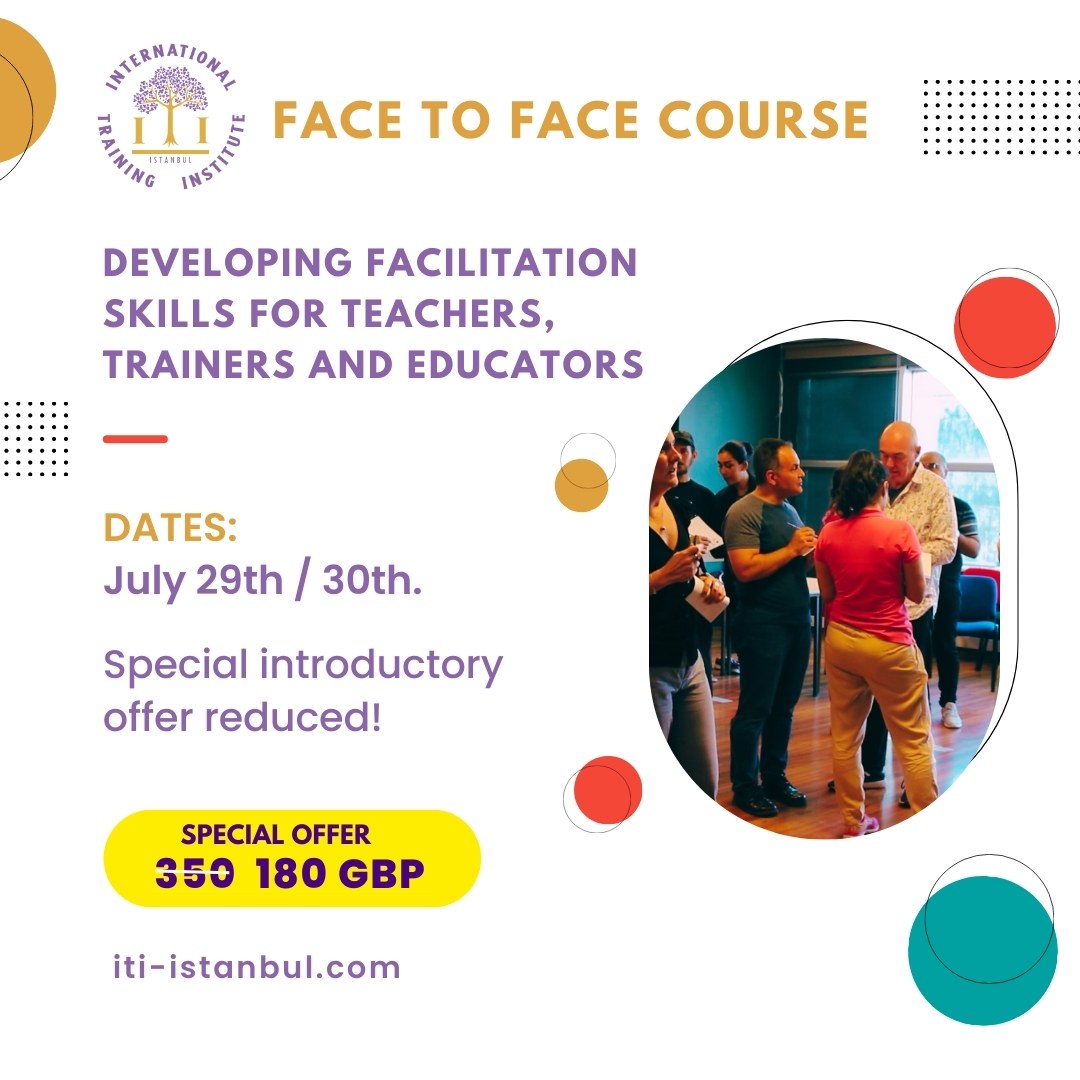
The weekend masterclass develops facilitation skills and is aimed at anyone who is involved in training, development and educating others.
Facilitation skills are vital in any event that involves creating a safe space for collaboration where people are interacting and discussing ideas to promote change.
The workshops explore the use of participatory approaches to professional development such as team building, gaining participants’ trust, maximizing engagement and fostering collaboration and personal disclosure.
The workshops are based on the premise that facilitation skills requires ‘presence’ and involves managing the physical, mental and emotional engagement of the participants.
The workshops also explore the use of community forums in personal and professional development. The workshops are adapted from techniques used in Forum Theatre devised by the Brazilian dramatist Augusto Boal.
Participants will learn the methodology and practice the techniques so after the programme they can apply these methods in their own contexts. This methodology provides an innovative framework for conducting professional development in institutions. It is participant centered and the issues are real concerns and challenges that participants face, while providing a safe space to frame the reflections and discussions. The methodology generates multi-voiced, multi-perspectival dialogue and is focused on finding solutions to real problems and inspiring action and change.
Led by Daniel Foley, a professional actor, who has performed in 64 countries worldwide; his one-man shows have received critical acclaim and he is the founding member of his current theatre company “Performance Exchange.” The workshop includes techniques used by professional actors to project, modulate and develop their voice.
Daniel Foley is a well-known Shakespearean specialist. His one man show brings alive all areas of Shakespearean Drama, from the tragic and macabre to the comic and historic with scenes from “Romeo and Juliet”, “Macbeth”, “Hamlet”, “The Tempest”, amongst others, with significant aplomb and participation of members of the audience. Highlights include impersonations of Marlon Brando and John Wayne taking on Shakespearean roles and an insight into some of the techniques used in hand and sword fighting on the stage. Daniel also shares his knowledge of Elizabethan theatre and tests the audience’s knowledge through an interactive quiz.
Developing Facilitation Skills for Trainers and Educators
Face to face courses at ITI Istanbul.
The course develops advanced facilitation skills and is aimed at anyone who is involved in training, development and educating others. Facilitation skills are vital in any event that involves creating a safe space for collaboration where people are interacting and discussing ideas to promote change. The workshops explore the use of participatory approaches to professional development such as team building, gaining participants’ trust, maximizing engagement and fostering collaboration and personal disclosure and simultaneously develops a range of many other performative skills. The workshops are structured on tried and proven methodology adapted from the participatory arts and used for training in community settings, care homes, hospitals and many institutions focusing on personal and professional development.
Participants will receive a certificate at the end of the course.
These series of workshops explore the use of community forums in personal and professional development. The workshops are adapted from techniques used in Forum Theatre devised by the Brazilian dramatist Augusto Boal.
Participants will learn the methodology and practice the techniques so after the programme they can apply these methods in their own contexts. This methodology provides an innovative framework for conducting professional development in institutions. It is participant (or company) centered (the issues are real concerns and challenges), while providing a safe space to frame the reflections and discussions. The methodology generates multi-voiced, multi-perspectival dialogue and is focused on finding solutions to real problems and inspiring action and change.
This paper is based on a series of diagnostic workshops conducted at a teacher training centre in Istanbul focusing on how participatory methodology can inform ELT Teacher Education. The workshops provided participants experience of participatory methodology and techniques to elicit feedback on their pedagogic value and efficacy in Teacher Education. Through dialogue and reflection, participants identify the facilitation skills they value from the workshops. While participatory methodology has a long and proven track record in Applied Theatre, education and development, it is rarely utilized in teacher development programmes. In particular we explored the use of Community Forums (an adaption of Forum Theatre) in which participants re-enact collectively experienced challenges in order to find solutions. Feedback from the workshops reveals that Community Forums provide participant-led, solution-oriented, multiple voiced opportunities for reflection and dialogue on critical incidents teachers’ face. Additionally, the workshops aim to initiate transformational change by developing participants’ facilitation skills. The research provides the initial diagnostic data to create teacher development programmes incorporating Community Forums and participatory methods.
1 Introduction.
Having just attended a series of professional workshops I am struck by a worrying paradox. Most ELT trainers and educators, while advocating lessons that are personalised, learner-centred and focus on communication and language use; in practice deliver training sessions that are tutor-centred, material driven (invariably structured by power point slides) that appear to aim primarily at the transmission of content. If trainers and educators do not set an example of how to encourage participatory learning, it is hardly surprising then that teachers often pay lip service to the concept of ‘facilitating learning’ while in reality they are stuck in the traditional conception of a teacher as a transmitter of information. We sorely need a framework and structured methodology for participant-led, solution-oriented professional development workshops.
One solution may lie in the methodology provided by the participatory arts. Participatory arts provide a form of expression which enables shared ownership of decision-making processes and aims to generate dialogue, reflection, and community cohesion. Adapting the principles and rationale of Forum Theatre I explored the use of participatory methodology (and Commubnity Forums in particular) for teacher professional development in a series of workshops at a teacher training centre in Istanbul. Community Forums are an adaptation of Forum Theatre which was developed by the Brazilian educator, dramatist, director Augusto Boal in 1973. Rooted in the Brazilian social movements of the 1950s and 1960s and based on Paolo Freire’s model of participatory education, it is designed to represent experiences of social and political oppression in order to stimulate community dialogue and problem-solving. Over 50 years later Forum Theatre has been shown to work successfully across a remarkable range of cultural, political, and social differences and demands. It has been used by peasants and workers, students and teachers, artists, social workers, psychotherapists, and NGOs, among others; in schools, streets, churches, hospitals, theatres, and prisons.
Community Forums can be seen as a methodology for generating both the participants’ understanding of their situation and the actions to improve them so, in other words, it provides both the content (problems) and the methods to interrogate reflection and elicit solutions. The procedure is relatively straight forward and easy for a novice facilitator to follow after basic training. Participants (teachers in our case) are invited to brainstorm and recall crtiical incidents from their experience of challenges / problems they have faced in their work and then share experiences with each other prior to re-enacting the scenarios in groups in order to reflect and diagnose solutions and alternative courses of action. Having investigated and rehearsed a number of scenarios, these then can be scaled up to a wider community by presenting them to an audience and inviting them to discuss and offer alternative solutions. The workshops aim at the education, personal growth and skills development of the participants as well as providing a diagnostic exploration of the efficacy of applying community forums in a professional development setting.
3 Objectives
My specific objectives for the workshops are fourfold.
1. Diagnostic: To provide an opportunity to experience community forums and to elicit participant-led feedback on their efficacy for teacher education.
2. Methodologic: Related to the above, to evaluate whether the methodology is appropriate and effective in teacher education settings (does it do what it claims to do).
3. Pedagogic: To elicit through dialogue and reflection what participants have learned from the workshops.
4. Transformational: To initiate action or change by providing opportunities to develop facilitation skills for participants to utilize in their own settings.
4 Procedure
The workshops were structured according to two components:
A.) Games and participatory activities and B). Community Forum interrogating the challenges of being an ELT teacher and eliciting creative solutions
A. Games and participatory activities.
The activities are designed to build and/or develop most, if not all, of the following:
The workshop structure relies on participation. Firstly, the workshops are built on the participants’ personal narratives and experiences. Sharing personal stories can be a powerful way of promoting teacher development through the sharing of experiences (McCabe 2002). Secondly it is inherently educational as the reflective and interactive processes promote self-aware, critically thinking participants. It encourages a ‘bottom up’ approach to change that is advocated in much literature on educational innovation and change (Fullan 2007).
The three (3 hour) workshops followed this format.
Workshop 1. Tilling the Soil.
Participants warm up to the concept of self-disclosure through activities in pairs and groups. Then we brainstorm the rewards of teaching before relating a story of positive achievement in groups which provides the stimulus for re-enacting the story through image theatre. In the final hour we repeated the cycle but this time brainstorming – challenges, obstacles, difficulties, and concerns of an ELT teacher.
Workshop 2. ‘Sowing the Seeds’
Participants focus on devising scenes for the community forum scenario. By the end of the workshop we have six scenes and a facilitator/ director allocated to each scene.
Stage 3 ‘Blooming’
Participants focus on developing facilitation skills and rehearsing the forum scenes. The scenarios are pressented to an audience in the Community Forum. The forum aims to stimulate discussion, reflection and debate amongst the audience who are also invited to participate in the search for solutions to the issues raised.
5 Findings and participant feedback
5.1 Real experiences / challenges
The aim of the community forum was to raise awareness and interrogate the challenges that teachers face and to explore solutions. After the first workshop I categorized these challenges into four groups for ease of reference:
1. Internal challenges (self-doubts, moods, energy levels, lack of confidence / knowledge)
2. External challenges (from administration, management, learners, parents and colleagues)
3. Contextual challenges (low pay, large classes, inappropriate methodology and materials)
4. Cultural challenges (poor communication, long hours, cultural differences)
When planning the workshops, I was concerned that the scenarios presented to the audience would lack authenticity. However, these comments suggest otherwise:
‘It shows the challenges of a teacher. It is nice to know you are not alone experiencing these kind of problems’
‘It mirrors real situations and presents them visually’.
Indeed, one audience member embodied the experience:
‘In the beginning I was so tense and I felt I was exactly the same as Asya (the protagonist), I even felt blank in the first 10 seconds after the show was over. Felt frustrated but then I started thinking how I could help her… things changed. I started to feel more confident. I could think outside the box again. I felt relieved.’
At the end of the second workshop one participant recognized that time and iteration are necessary for depth and wrote: ‘I believe this kind of training will be more ‘fruitful’ if done several times. I mean problems to focus on will get more challenging and therefore the issues raised will be more thought provoking.’
5.2 Metaxis / dramatic distance.
Participants noted that re-enacting the fiction provided space for reflection. Boal (1995, p.43) refers to the term metaxis to describe the idea of living in an imaginary world which creates a dialectic between fiction and reality so knowledge acquired in the fictional world is transferable to the real world through imaginative play. The benefits of drama to provide ‘distance’ was mentioned by participants as in these examples: ‘I think they open some doors and give perspective about real life problems. Watching other people and seeing the problems acted provides a distance from the problem. So I can think better to find a solution.’
When dramatizing critical incidents participants experience a condition of in-between-ness, a liminal space between reality and fiction. This duality creates both tension and imaginative possibilities that are crucial elements in a training context. Through imagining what it might be like to be another, at the same time as being themselves, participants experience ‘me/not me’ (Schechner, 1985). Transformative theories of learning (Mezirow, 1997) propose that learning occurs when the participant faces a challenge, either an accumulation of experiences over time or a sudden trauma. The state of disequilibrium triggers reflection and critical assessment.
5.3 Reflection and Dialogue.
When prompted to consider the benefits for professional development two comments from the audience included:
‘Confidence, talking about the issues via fictional characters makes people feel better (a bit of therapy) becoming more aware of what happens in their schools’.
‘Imagined situations may be perceived as less confrontational’
Each scenario in our performance highlighted problematic issues involving our teacher protagonist facing challenges. At the end of the event, we had a feedback discussion in which the audience reflected on the experience.
5.4 Participant-led.
By delegating content creation to the workshop participants, the conventional power discrepancy is overturned allowing for participant centred input. This flexibility in facilitation allows for creation of a zone of proximal development for the participants and shifts the responsibility for learning from the facilitator to the participants (Vygotsky, 1986). The zone of proximal development is a concept introduced by Vygotsky to describe the space between ‘not able to do’ and ‘able to do’. In this space participants seek solutions with support from the audience.
One key objective of the workshops is to assess their pedagogic value. One factor that emerged was that as the content was participant led, this allowed space for creativity. One participant commented: ‘It was lovely watching the things that were crafted by people, from nothing‘.
5.5 Change and transformation
A key aspect of the methodology is the degree of change and transformation of the participants. In the final workshop I invited participants to comment on how the workshops assisted in their professional development. Many comments referred to the methodology itself; ‘Creating alternative solutions, scenarios, paths of experience’; ‘Exploring issues that concern teachers can clarify things and help find solutions;’ Many participants commented on the relationship between challenge and enjoyment: ‘It was scary at first, but then, it was fun’. In terms of learning and development there is a need for challenge, as Sawyer (1999) highlights: ‘Change is always connected to the willingness to take risks in going beyond what is known and familiar’.
5.6 Scalability
One key advantage of community forums in terms of teacher development is that the procedure can be scaled up to involve large numbers of participants in a short time period. Simply by training an initial modest cohort of 12 community forum facilitators, if these facilitators subsequently conduct workshops for a further 12 participants and then present their community forums to audiences of 200 teachers, within a limited period more than 2,500 teachers will have been exposed to the issues and had an opportunity to discuss and generate solutions. The forums can be expanded to include other stakeholders such as School Principals, learners, and parents. In addition the impact of the forums in terms of audience responses and committment to finding solutions is visible. The forum can be filmed and/ or audience feedback obtained to provide tangible evidence of impact to sponsors.
5.7 Limitations
One audience member recognised that a representative range of stakeholders are needed to have a genuine interrogation of the issues: ‘Through these workshops we can actually educate heads of department, principals of schools, managers and even teacher trainers in order to create a healthier working environment.’
When asked whether institutions would be interested in professional development using Community Forums there was a mixed response. ‘The institutions are interested in making money. I think they don’t care for using professional development that needs a lot of time and costs a lot maybe’.
‘Here is the point, sometimes people prefer the old-fashioned techniques (books, homework and old rules) so they are not accepting new things.’
6 Conclusion
Community Forums operate at the facilitative, open end of the teaching / training continuum and therefore are liable to elicit more fervent participant responses, interaction and dialogue. Community Forums epitomise an interactionist, participatory approach to learning espousing the philosophy that the process of meaningful dialogue and interaction and the flow of ideas is where learning occurs.
We can conclude by revisiting our initial objectives for the workshops.
1. Diagnostic.
The workshops generated reflection and discussion that provided valuable information about participants perspectives of Community Forums and its relevance to their development as teachers.
2. Methodology.
Despite some limitations, such as potential lack of acceptance by institutions and other stakeholders, we can conclude that Community Forums provide participant-led, authentic content to generate solution oriented interventions, reflection, and dialogue of lived experience as well as offering a safe, fictional distance to encourage personal disclosure and multiple perspectives.
3. Pedagogic
Participants identified numerous facilitation skills that emerged primarily through the games and activities. The methodology provides participants opportunities to develop facilitation skills of raising their awareness of self, others and reflect on their beliefs, behaviour and feelings. These facilitation skills are rarely addressed in teacher education where the focus is primarily on a cognitive, instrumental orientation rather than towards a performative-humanistic understanding of “teaching and learning with head, heart, hands, and feet” (Schewe, 2013, p. 7).
4. Transformational
My aim in conducting the workshops is to stimulate action and change. The workshops are a pilot project to explore the efficacy of Community Forums and how to develop the skills of facilitators who can then disseminate the methodology. After my initial diagnostic workshops I have created two short courses: 1) A week intensive training to develop facilitator skills; 2) Three (3 hour) workshops leading to a Community Forum (see Appendix A). The overall aim is to introduce teachers to a range of techniques to raise awareness of the participatory arts in general and the us of community forums in particular and reveal a fresh landscape of creative personalised expression, enjoyment and gratification.
Works Cited
Boal, A., 1995. The rainbow of desire: the Boal method of theatre and therapy. Routledge, London; New York.
Freire, P., 1995. Pedagogy of the Oppressed. Continuum, New York.
Fullan, M., 2007. The new meaning of educational change, 4th ed. ed. Teachers College Press, New York.
Mezirow, J., 1997. Transformative Learning: Theory to Practice. New Directions for Adult and Continuing , Volume 1997, pp. 5 – 12.
McCabe, A., 2002. A Wellspring for development. IATEFL Publications 82–96.
Schechner, R., 1985. Between theatre and anthropology. Philadelphia, PA: University of Pennsylvania Press.
Schewe, M., 2013. Taking stock and looking ahead: Drama pedagogy as a gateway for performative. Scenario: Journal for Performative Teaching, Learning and Research, Volume 8, pp. 5 – 23.
Vygotsky, L., 1986. Thought and language. Cambridge, Massachucetts: MIT.
7. Appendix
Developing Facilitation Skills for Trainers and Educators
These series of workshops explore the use of community forums in personal and professional development. The workshops are adapted from techniques used in Forum Theatre devised by the Brazilian dramatist Augusto Boal.
Participants will learn the methodology and practice the techniques so after the programme they can apply these methods in their own contexts. This methodology provides an innovative framework for conducting professional development in institutions. It is participant (or company) centered (the issues are real concerns and challenges), while providing a safe space to frame the reflections and discussions. The methodology generates multi-voiced, multi-perspectival dialogue and is focused on finding solutions to real problems and inspiring action and change.
Identifying Performative and Meta-Performative Skills pertinent to Teacher Development.
This article is based on a series of diagnostic workshops conducted at a teacher training centre in Istanbul focusing on how Performative Pedagogy can inform Teacher Education. Performative Pedagogy provides embodied, participant-led, solution-oriented, multiple voiced opportunities for reflection and dialogue on critical incidents teachers’ face. In addition, participants highlighted a number of performative skills pertaining to developing awareness of self, others and setting that are fundamentally ignored in current competence-based teacher education programmes. Finally participants uncovered meta-performative skills revealing aspects of their identity and reflection on why teachers act in the way that they do.
Background to the workshops
I work in a teacher training centre in Istanbul training pre-service and in-service teachers from a spectrum of cultures and linguistic backgrounds. The environment demands self-aware, reflective teachers who are collaborative, demonstrate inter and intra-personal qualities, adaptable, able to embrace diversity in multi-cultural and multi-linguistic contexts while solving emergent problems, adopting a range of roles and in most cases having to perform in a language which is not their mother tongue. Typically, the teacher education they receive focusses on cognitive, instrumental and propositional knowledge leaving them often feeling ill-equipped, disillusioned and ill-prepared to meet the behavioral challenges of teaching a class in situ. To fill this gap, I have turned to performative pedagogy and to an examination of its applicability to teacher education.
Performative approaches to learning demands skills that combine physical, cognitive and affective domains. Teaching is performative in that it is based on judgements formed through action (heuristic); it is influenced by contingencies that happen in real time and are unpredictable (improvised); it involves physical and emotional engagement (embodied) and learning is created in the process (emergent). “Teachers are taught how to instruct but not how to engage their students emotionally”. (Wahl, 2011, p. 21).
Post pandemic it is opportune to consider the importance of the embodied physical presence of learners and teachers in the learning encounter as this raises fundamental issues as to the nature of teaching and learning. Teachers are rarely trained in skills to assist them to be physically present, emotionally aware and able to improvise creatively to emergent needs. The potential of embodied methodologies and the need to acquire performative skills is ignored in teacher education which remains firmly entrenched in a competence driven paradigm. Metaphorically teacher education provides ‘the map’ (the official version of the journey route) but omits ‘the story’ (the feelings of the journey’s experience).
Research on teacher education has moved somewhat from defining what a teacher is, does or believes to a more ‘bottom up’ perspective of examining how teachers learn (Allwright 2001). Despite a move to more teacher introspection, teacher education is still rooted to the assumption that teachers need core disciplinary knowledge (Yates and Muchisky 2003) and knowledge of pedagogic skills which will be moulded into expertise through classroom experience. In contrast the underlying philosophy behind performative pedagogy is that there is a direct relationship between affective, cognitive and physical domains so we need to ‘feel’ something as well as understand it. Vygotsky refers to ‘perezvanhie’ a Russian term meaning ‘learning through experience’. In other words, we need to experience the state of confusion (liminality), a state of being in limbo between knowing and not knowing, before transformation is possible. Development is conceptualized as participatory, action oriented, holistic and requires a performative-humanistic understanding of ‘teaching and learning with head, heart, hands and feet’ (Schewe, 2013).
Definition of Performative.
The term ‘performative’ was first coined by Austin in 1962 to refer to a limited set of verbs that both describe and require the performance of the act simultaneously: ‘I name this ship Titanic’. The term was picked up 20 years later by Postmodern thinkers (Derrida, Habermas, Bourdieu) who re-defined ‘performativity’ to include any iterative action that involves social interaction and presence (embodied), indeed any action that involves people coming together to communicate meanings and affirm cultural and social values (i.e. protest marches, sports events, political rallies, concerts). Today with the advent of Performance Studies performativity has a wide remit encompassing gender, race and has opened up significant ways for rethinking language and identity.
Features of Performative Pedagogy.
Performance pedagogy has evolved from ‘drama in education’ (pioneered by Heathcote in the 1960s) and is inherently participant centred. The key characteristics are role playing, improvisation, context specific topics and reflection and discussion on the part of the participants. Like Heathcote, the dramatist Augusto Boal’s philosophy (as depicted in his book ‘Theatre of the Oppressed’) involves learning through re-enactment of scenarios but differs in that learning starts with an awareness and analysis of the present context (oppressions) and involves re-enactment and reflection to uncover solutions and promote action/ change. Boal’s methodology is indebted to his mentor the pedagogue Freire who foregrounds the movement of powerless (oppressed) people from being acted upon (objects) to initiating action and becoming subjects of their own lives. For Freire this process of ‘conscientization’ is dependent on replacing the banking system of education (filling learners with the academy’s version of knowledge) with a dialogic approach to learning. So, while Freire broke the hierarchical divide between teacher and student, Boal did so between performer and audience and by extension performative pedagogy conducts a similar dismantling of the positioning of Teacher and Teacher Educator.
The Findings
These workshops, by identifying the performative and meta-performative skills required by teachers contributes to both the participants’ personal development as well as informing Teacher Education in general. No doubt that becoming more aware of who you are and where you are going is key to professional development. Teachers share experiences and commonalities, become more comfortable with personal disclosure, and come to experience and enjoy a new level of articulation and self-efficacy.
Workshop Objectives
1. Diagnostic.
The workshops generated a lot of written data, oral reflection and discussion that provided valuable information about participants perspectives of Performative Pedagogy and how it is relevant to their development as teachers.
2. Methodology.
Performative Pedagogy provides participant-led, authentic content to generate solution oriented, embodied interventions, reflection, and dialogue of lived experience as well as offering a safe dramatic, fictional distance to encourage personal disclosure and multiple perspectives.
3. Pedagogic
Participants identified numerous performative and meta-performative skills that emerged primarily through the workshop activities. The methodology provides participants opportunities to develop performative skills of raising their awareness of self, others and their context and reflect on their beliefs, behaviour and feelings while performing the activities (meta-performative).
4. Transformational
There is a need for training in performative methods and for educational practices to understand the potential of the arts in transforming consciousness, refining the senses, and enlarging the imagination, and requiring teachers with awareness of performative skills. Performative Pedagogy introduces teachers to a range of techniques to raise awareness of the performative and reveal a fresh landscape of creative embodied expression, enjoyment and gratification.
References
Allwright, R, 2001. Three major processes of teacher development and the appropriate design criteria for developing and using them, in: Research and Practice in Language Teacher Education: Voices from the Field. CARLA, Minneapolis, pp. 115–134.
Schewe, M., 2013. Taking Stock and Looking Ahead: Drama Pedagogy as a Gateway to a Performative Teaching and Learning Culture. Scenario 2013.
Yates, R., Muchisky, D., 2003. On Reconceptualizing Teacher Education. TESOL Quarterly 37, 135.
Wahl, S., 2011. Learning to teach by treading the boards. In Key Concepts in Theatre/Drama Education (pp. 19-22).
This is a blog for teachers interested in teacher education, teacher training and development, teaching and learning and related topics. We will be inviting a variety of people to share their experiences on a regular basis – so keep coming back!.
The latest post is by Galina an ITI DELTA student working in Samara, Russia. She describes the three-day ITI Master Classes held at her University. Liz and I had a wonderful time and thank Galina for inviting us and also writing it up for our blog.
I have written the first two posts to get the ball rolling. My first post is about ‘whole person learning’ and explains my personal philosophy that learning should utilise the whole person in terms of stimulating the mind, body and emotions.
My second post is also personal and describes my experiences over the last two years facing cancer. Like staring down from a precipice, confronting our fragile mortality is terrifying, and yet, at the same time by confronting the inevitable, it provides a unique opportunity to perceive from a new and sharper perspective and to learn valuable lessons about the nature of learning and life.
A teacher guides a student through classwork in a warmly lit classroom.
Should teachers correct every mistake their learners make?
It sounds like a simple question, but Tatiana Terekhova’s recent workshop showed why the answer is much more interesting than a simple yes or no.
Her starting point was deliberately provocative: the suggestion that teachers who do not correct every learner error are somehow failing to do their job. Instead of simply rejecting that claim, Tatiana invited participants to examine their own beliefs and classroom choices.
How strict are you about mistakes? When do you correct? When do you wait? Who should do the correcting — the teacher, the learner, or their peers?
Very quickly, the discussion revealed an important principle: effective feedback depends on context.
If learners are completing an accuracy-focused grammar task, immediate correction may be useful. If they are trying to develop fluency, constantly interrupting them may do more harm than good. Age, level, confidence, the lesson aim and the nature of the task can all influence the decision.
This is where error correction becomes directly relevant to Teaching Artistry.
Teaching is a series of choices
The artistic teacher does not simply apply a fixed rule.
They notice.
They interpret.
And then they choose.
A learner makes a mistake during a conversation. The teacher could interrupt immediately, make a note for later, encourage self-correction, invite a peer to help, recast the sentence, provide a clue — or perhaps decide that this particular mistake does not need attention at all.
None of these choices is automatically the “correct” one.
The important question is:
What will best support learning at this moment?
Teaching Artistry lives in these small professional decisions.
Mistakes are evidence of learning
One of the strongest ideas running through the workshop was that mistakes do not have to be treated as failures.
They are evidence that learners are experimenting with language.
This changes the emotional climate of the classroom.
If every attempt is immediately interrupted and corrected, learners may gradually become more concerned with avoiding mistakes than with communicating.
Tatiana demonstrated this with an intentionally exaggerated example. A learner tried to speak freely while the teacher interrupted repeatedly to correct grammar and word choice.
The result was technically attentive teaching — almost every mistake was noticed — but the conversation itself was being destroyed.
Participants quickly recognised the problem.
The goal is not to notice less.
It is to decide more carefully what deserves attention now, what can wait, and what may not need correcting at all.
The learner is not a passive recipient
Another important idea emerged when participants discussed learners who insist:
“Please correct all my mistakes.”
It can be tempting simply to comply.
But Tatiana suggested another possibility: explain the learning process.
Teachers can tell learners why they may correct some mistakes immediately, save others for delayed feedback, or sometimes prioritise communication instead.
This reflects a central principle of Teaching Artistry: learners are participants in the learning process, not passive objects of teacher decisions.
When learners understand why teachers make particular choices, feedback becomes something done with them rather than to them.
Beyond correction
Perhaps the most useful shift in the workshop came when Tatiana moved from error correction to feedback.
Feedback is much broader than:
“That’s wrong.”
It can also ask:
What did you do successfully?
What helped you complete the task?
What could make your performance even more effective next time?
Tatiana introduced the idea of using success criteria based on lesson aims. If learners are practising storytelling, for example, feedback might focus on whether they used narrative tenses, sequencing expressions, appropriate vocabulary and clear organisation.
The lesson aim therefore becomes something learners themselves can use to reflect:
Did I do this?
Did I achieve that?
What still needs work?
This moves feedback away from judgement and towards awareness.
Feedback as an act of attention
This may be the strongest connection with Teaching Artistry.
Feedback begins with attention.
The teacher listens not simply for errors, but for development.
What is this learner trying to do?
What is working?
What is getting in the way?
What feedback will help without damaging confidence, fluency or willingness to communicate?
The skilled teacher does not correct everything simply because they can hear everything.
They make choices.
Sometimes they intervene.
Sometimes they wait.
Sometimes they encourage learners to help one another.
And sometimes the most useful response is simply to let the conversation continue.
Teaching Artistry is often found in exactly these moments — in knowing not only how to act, but when.
Perhaps the question is therefore not:
“Did I correct all the mistakes?”
A more useful question might be:
“Did my feedback help this learner move forward?”
That is a very different way of thinking about correction.
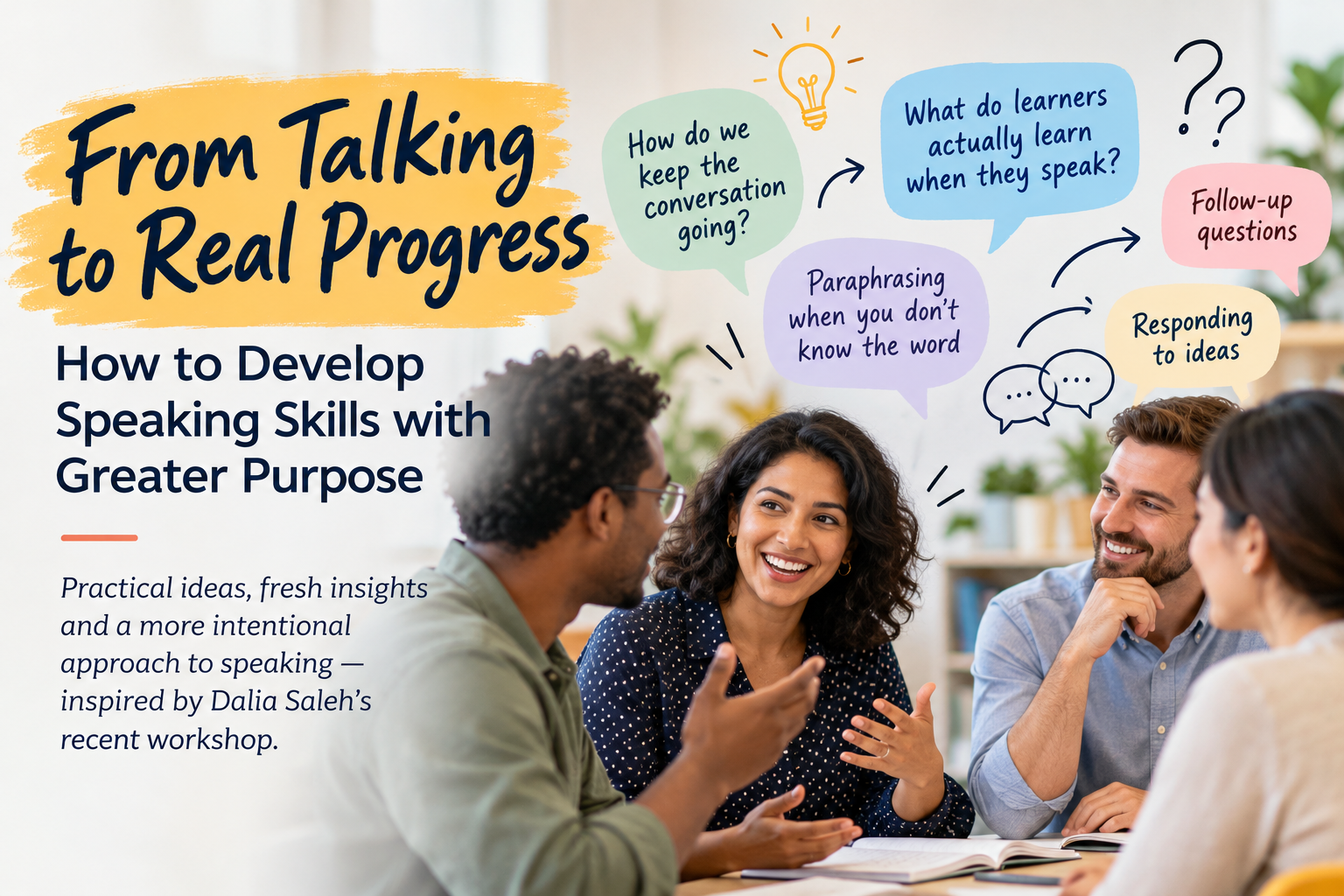
Beyond “Just Speaking”: Developing Speaking Skills with Purpose
Speaking lessons are often lively. Students discuss interesting topics, work in pairs, use useful phrases and spend plenty of time talking.
But are they actually becoming better speakers?
That was the central question in Dalia Saleh’s workshop, Beyond “Just Speaking”: Developing Speaking Skills.
Dalia began by giving participants a short speaking lesson. They discussed working from home and used expressions such as “from my perspective” and “I couldn’t agree more”. It felt like a familiar and effective speaking activity.
Then she asked a different question:
What did you actually learn to do better as a speaker?
That question changed everything.
Speaking practice is not always speaking development
Learners may speak a lot without developing a particular subskill.
They may express opinions, but not know how to maintain interaction.
They may talk in pairs, but rarely ask follow-up questions.
They may communicate successfully, but struggle to paraphrase when they cannot find a word.
They may speak at length, but organise their ideas poorly.
This means that a speaking lesson needs more than a topic and a discussion task. It needs a clearer sense of what learners are trying to improve.
Instead of asking only:
“What will my learners talk about?”
we can also ask:
“What do they need to become better at doing while they speak?”
That might mean developing fluency, organising turns, paraphrasing, responding to a partner, asking follow-up questions or keeping a conversation going.
Teaching Artistry as purposeful attention
This connects strongly with Teaching Artistry.
Teaching Artistry is not only about creativity, charisma or engaging activities. It is also about attention.
What is the teacher listening for?
What do we notice when learners interact?
A learner who hesitates repeatedly may need more than “speaking practice”.
A quiet learner may need support with interactional strategies.
A learner who stops whenever they forget a word may need ways to paraphrase or describe.
The more carefully we notice what learners are actually doing, the more useful our teaching choices become.
Diagnose before you intervene
One of the useful principles in Dalia’s workshop was to start with the learner difficulty.
Different speaking problems require different kinds of support.
A learner who pauses after every few words may need planning and fluency work.
A learner who cannot find vocabulary may need communication strategies.
A learner who does not respond to their partner may need help with small interactional moves such as reacting, picking up an idea and asking a follow-up question.
Speaking is not one skill.
It is a collection of behaviours that teachers can help learners notice and practise.
Making the invisible visible
Many of the skills involved in successful conversation are easy to overlook.
Fluent speakers react naturally, ask questions, repair misunderstandings and build on what others say.
Learners may not know how to do these things yet.
The teacher’s role can be to make these small moves visible.
A simple dialogue can become a noticing task:
What keeps the conversation going?
Where does one speaker respond to the other?
Which question encourages the speaker to continue?
Learners can then try the same strategies in their own conversations.
The teacher as designer of attention
This offers a useful way of thinking about Teaching Artistry:
The teacher designs attention.
We help learners notice language.
We help them notice how interaction works.
And we train ourselves to notice what learners need.
That also changes monitoring.
Instead of simply asking, “Are they speaking?”, the teacher can listen for something more specific:
Are they asking follow-up questions?
Are they extending one another’s ideas?
Are they paraphrasing?
Are they organising their turns more clearly?
The clearer our attention, the more purposeful our feedback becomes.
Beyond “just speaking”
A good speaking lesson does not always need more activities.
Sometimes it needs a sharper focus.
Not only:
“What topic will they discuss?”
But:
“What will they become better at doing as speakers?”
That small shift moves us from activity to intention.
From talking to development.
And from managing speaking tasks to developing the human skills that make communication possible.
That is where speaking pedagogy becomes part of Teaching Artistry.
Culture is always present in a language classroom.
It shapes the way people greet one another, make requests, disagree, show respect and interpret behaviour. It also influences how teachers understand learners and how learners understand one another.
Sabrina Bhar’s workshop explored how teachers can make this cultural dimension more visible and more purposeful. Her central message was that culture does not need to be taught as a separate topic. It can be woven into grammar, vocabulary, speaking, reading and everyday classroom interaction.
That makes it closely connected to Teaching Artistry.
Teaching Artistry is not only about creativity or engaging activities. It is also about how teachers notice, interpret and respond to the people in front of them.
Culture is more than food and festivals
When we hear the word culture, we often think first of food, traditions, clothes or celebrations. These can be useful starting points, but culture also appears in everyday communication.
How direct should a request be?
How much eye contact is appropriate?
How do people show respect?
What counts as polite disagreement?
These questions matter because teachers can easily interpret behaviour through their own expectations.
Imagine a learner saying:
“Give me the answer.”
A teacher might immediately hear this as rude. But there may be other possibilities. The learner may have limited English, may be translating directly from another language, or may simply be unaware of how the phrase sounds in English.
The important question is not whether one interpretation is correct. It is whether the teacher is willing to pause and consider other possibilities.
That shift from judgement to curiosity is central to Teaching Artistry.
Teaching as interpretation
Teachers are always interpreting what happens in the classroom.
A learner is silent.
Someone speaks very directly.
A student avoids eye contact.
Another dominates a group discussion.
The artistic teacher does not simply react. They notice, reflect and choose how to respond.
This does not mean ignoring inappropriate behaviour. It means recognising that our own assumptions are also part of the classroom.
Teaching Artistry involves becoming more aware of those assumptions so that we have more choices in how we respond.
Culture as exploration
One useful way to approach culture is through a process of experience, comparison, analysis, reflection and action.
Learners encounter a practice, compare it with their own experience, explore similarities and differences, reflect on what those differences might mean, and consider how they might respond.
The aim is not to decide which culture is better.
It is to deepen understanding.
This creates interesting possibilities for language teaching. A menu, message, video clip, advert, train ticket or social-media post can all become starting points for cultural exploration.
The key is in the questions we ask.
What seems familiar?
What is different?
Why might people do this?
What assumptions are we making?
Could there be more than one appropriate way to behave?
Connection through culture
Sabrina also shared an activity based on food traditions.
Learners did not simply describe dishes. They talked about what those foods meant in their lives: celebrations, family traditions and important occasions.
This created something richer than vocabulary practice.
Learners discovered that although the dishes might be different, the human meanings behind them were often similar: belonging, celebration, hospitality and memory.
This is where cultural exploration connects particularly strongly with Teaching Artistry.
Language becomes a way of discovering other people.
Avoiding stereotypes
Cultural comparison can also be risky if it leads to generalisations such as “People in this country always…” or “In that culture they…”
Teachers can help by encouraging more careful language:
“In my experience…”
“In my family…”
“Some people I know…”
“I have noticed that…”
This keeps the focus on experience rather than stereotype.
The goal is not to make learners experts on one another’s cultures. It is to help them become more curious, more reflective and more careful about what they assume.
Teaching Artistry and teacher presence
Teacher presence is not only about confidence or charisma.
It is also about stance.
Are we curious?
Are we willing to reconsider our first interpretation?
Can we create space for different experiences?
Can we compare without judging?
Can we help learners stay open to uncertainty?
These choices shape how a classroom feels.
Bringing culture into the language classroom is therefore not simply about adding extra content.
It is about becoming more attentive to the human beings already present.
What a Simple “Getting to Know You” Activity Can Teach Us About Teaching Artistry
One of the most revealing moments in Oksana Yeshshyorkina Baylan’s workshop came from an activity that could easily be dismissed as an icebreaker.
Participants were asked a simple question: tea or coffee?
They responded in the chat. Then Oksana invited a few people to explain their choices.
Very quickly, the answers became more than preferences. One participant spoke about drinking tea with other people but coffee alone. Another talked about missing Turkish coffee shops after moving country. Someone else connected Turkish tea with memories of studying at ITI. What began as a binary choice opened into stories, identities, memories and relationships. That is what made this workshop particularly relevant to Teaching Artistry.
It showed how a seemingly ordinary classroom activity can become a space for connection, responsiveness and human presence.
The activity is simple. The interaction is not.
Oksana’s workshop, “Getting to Know You”, was built around activities designed to help teachers and learners make connections. From the beginning, she positioned the session as experiential: participants would connect, play, discover and then redesign or adapt ideas themselves. She planned to use chat, reactions and breakout rooms rather than simply talk about relationship-building.
The first activity, “This or That”, required almost no materials. Participants chose between alternatives such as:
tea or coffee;
plan or improvise;
games or projects.
The important part came after the choice. Oksana asked participants why.
This changed the activity. Instead of a quick poll, it became an invitation to reveal something of themselves.
The answers also became progressively richer. When participants discussed whether teachers should plan or improvise, they began talking about responsiveness to learners, changing a lesson in the moment, and balancing preparation with flexibility. One participant described planning as having a set of possible choices rather than a fixed route. Another argued that good teachers need to improvise when classroom reality does not match the plan.
This is where the activity moves beyond “getting to know you”.
It begins to reveal teachers’ beliefs.
Teaching Artistry begins with attention
Teaching Artistry is not simply about being entertaining, charismatic or creative. It is about becoming more attentive to what is happening between teacher, learners and the situation itself.
Oksana’s activity demonstrates this beautifully.
The teacher begins with a structure: two choices and a question.
But what happens next cannot be completely predicted.
A learner gives an unexpected answer. Another person connects with it. Someone tells a story. A disagreement appears. A new topic emerges.
The artistry lies partly in noticing these moments and deciding what to do with them.
Do we move on because the next slide is waiting?
Or do we recognise that something valuable has appeared?
In Oksana’s workshop, the participants themselves began creating much of the content. The discussion about games and projects, for example, developed into reflections on different kinds of motivation and the longer-term learning that projects may generate.
The workshop therefore demonstrated something central to performative and embodied teaching: lessons are not simply delivered. They are co-created in real time.
Low-threshold participation matters
Another interesting feature of “This or That” is how little it initially asks from participants.
You can simply type “coffee”.
That is enough.
But you can also explain why. You can tell a story. You can disagree. You can connect your answer to your professional beliefs.
One participant made precisely this point during the workshop: someone can participate at their own level. They may only make a choice, but they have still entered the interaction.
This is an important principle for Teaching Artistry.
Participation does not have to begin with a large performance demand.
Teachers can create different entry points.
A reaction emoji.
A single word in chat.
A binary choice.
A short explanation.
A story.
A conversation.
What matters is that the activity creates the possibility of moving from low-risk participation towards fuller presence.
That is particularly important in online teaching, where silence can easily be interpreted as disengagement. Oksana showed how simple technological tools—chat, reactions, microphones and breakout rooms—can create multiple ways of entering the shared space.
From activity to awareness
Another strong feature of the workshop was that Oksana did not simply demonstrate activities.
She stopped and asked participants to examine what had happened.
After the “This or That” sequence, she asked how much the group had learned about one another and how an activity like this might help quieter learners participate.
Participants identified several possibilities: breaking the ice, discovering learners’ preferences, encouraging speaking and giving teachers an early sense of the group.
This reflective move is significant.
The difference between collecting activities and developing teaching artistry is often reflection.
An activity may be enjoyable.
But what is it doing?
Who is able to participate?
What kind of interaction does it generate?
What does the teacher learn by watching?
What possibilities emerge that were not originally planned?
These are questions that shift attention from technique towards artistry.
The teacher as participant
Oksana’s second activity pushed this idea further.
She displayed numbers connected with her own life—2, 39 and 13—and asked participants to guess what they represented. The answers turned out to include two cats, her shoe size and her years of teaching experience. She then invited participants to repeat the activity with one another in breakout rooms.
Again, the technique is extremely simple.
What makes it powerful is reciprocity.
The teacher is not merely extracting information from learners. She contributes something of herself.
That small act changes the relationship.
In Teaching Artistry, teacher presence is not necessarily created through performance in the conventional sense. It can be created through appropriate self-disclosure, humour, responsiveness and willingness to participate in the same human exchange we ask of learners.
Connection is not an extra
Perhaps the most important message from this part of Oksana’s workshop is that connection is not something that happens before the “real lesson”.
Connection can be the mechanism through which learning begins.
A tea-or-coffee question can generate narrative.
A planning-or-improvising choice can expose professional beliefs.
A number can provoke curiosity.
A brief exchange can give a quieter learner a first opportunity to speak.
None of these requires sophisticated technology or elaborate materials.
They require something more fundamental: attention to people.
That is why Oksana’s workshop connects so naturally with Teaching Artistry. It reminds us that teaching is not simply the presentation of content. It is the creation of conditions in which people are willing to enter the room, reveal something of themselves, respond to others and become part of a shared experience.
Sometimes that begins with something as simple as:
Reflections from Fatimah Alsharif’s Teaching Artistry workshop on engaging learners
When we talk about learner engagement, the conversation often turns quickly to activities: games, pair work, group work, technology or new ways of presenting language. These can certainly help. But Fatimah Alsharif’s recent workshop, Engaging Students in the English Classroom: Practical Strategies for Teachers, pointed towards something deeper.
Engagement is not simply about what activity a teacher chooses. It is also about how it feels to be a learner in that classroom.
Do I feel safe enough to speak? Will I be given enough time to find the words? What happens if I make a mistake? Does the teacher notice me? Do I feel that what I am being asked to do is achievable? Am I genuinely participating, or merely watching the teacher teach?
These questions take us to the heart of Teaching Artistry.
When disengagement is not a motivation problem
At the beginning of the workshop, participants identified many reasons learners may withdraw: fear of making mistakes, boring or inappropriate topics, excessive teacher talk, lack of understanding, low motivation and teacher-centred lessons. Fatimah grouped these broadly into language-related, emotional and classroom-related factors.
This is an important shift in perspective.
A quiet learner is not necessarily an unmotivated learner. A student who refuses to answer may be protecting themselves from embarrassment. Another may have stopped participating because tasks repeatedly feel beyond their reach. Others may simply have learned that the safest role in the classroom is to remain invisible.
One participant described students who spoke confidently in one-to-one lessons but became silent in groups because they feared being judged or teased by classmates.
Engagement, then, is partly relational. Before asking, How can I make this activity more exciting?, we might ask:
What is happening in the emotional space of this classroom?
The classroom as an emotional environment
One of Fatimah’s strongest messages was the importance of creating a classroom in which mistakes are accepted. She reminded participants that teachers make mistakes too and argued that learners need to know that imperfection is a normal part of learning.
This may sound obvious, but learners do not discover that a classroom is safe because we tell them it is safe. They discover it through repeated experience.
They notice our face when an answer is wrong.
They notice whether we interrupt.
They notice how long we wait.
They notice whether another learner is allowed to dominate.
They notice whether their partial answer is treated as a contribution or a failure.
These are small, often unconscious, performative signals. Together they communicate who is entitled to speak and what happens when someone takes a risk.
Teaching artistry therefore involves more than knowing techniques for error correction. It includes an awareness of the emotional meaning of our behaviour.
A pause can communicate patience.
A smile can communicate encouragement.
Moving too quickly to another learner can communicate: Your answer wasn’t good enough.
The moment that matters
Fatimah illustrated this through a simple classroom case.
A teacher explains the present simple at length and then asks Ali what he usually does after school. Ali looks down, hesitates and eventually gives a short but essentially successful answer. Rather than developing his contribution, the teacher turns to another student. Later, when students are invited to volunteer answers, Ali remains silent.
The workshop participants immediately recognised the significance of this moment.
Ali had spoken.
He had taken a risk.
The teacher had an opportunity to acknowledge that success, perhaps responding positively and asking a small follow-up question. Instead, the interaction moved on. Participants suggested that Ali could easily interpret the comparison with the stronger learner as evidence that his contribution had failed.
This is a useful example of what we might call a micro-moment of teaching artistry.
Nothing dramatic happens. There is no major methodological error. But a few seconds of classroom interaction may influence whether a learner chooses to participate the next time.
Skilled teaching therefore requires more than planning what comes next. It requires noticing what is happening now.
From performing teaching to facilitating learning
Another recurring theme was teacher talk.
Fatimah openly reflected on moments when she finds herself explaining for too long and then realises that her students have become passive listeners. Participants similarly argued that pair work, group work and discussion can transform learners from an audience into participants.
But simply putting students into groups does not automatically create engagement.
Participants pointed out that stronger learners may take over, quieter learners may disappear, and groups may drift away from the task. The teacher’s role therefore becomes one of facilitation: establishing clear purposes, monitoring participation, varying groups and creating structures in which everybody has a meaningful role.
This is central to Teaching Artistry.
The teacher does not disappear. Rather, teacher presence changes.
Instead of occupying the centre of every interaction, we create conditions in which learners can occupy more of the space themselves.
The artistry lies in knowing when to lead, when to step back, when to intervene and when to allow an interaction to develop.
Engagement has a body
One participant introduced another important dimension: movement.
She described how even adult conference participants became more energised when they were asked to stand, stretch, change partners or move around the room. She connected this experience to classroom practices such as changing groups, posting ideas on different walls and physically moving between activities.
This reminds us that learners do not enter our classrooms as disembodied brains.
Attention is physical.
Energy is physical.
Interaction is physical.
A classroom in which learners remain seated, facing forward and listening for long periods communicates a particular role: spectator.
Changing the physical pattern of a lesson can change the social pattern as well.
Turning towards another learner changes who owns the conversation. Standing up can change energy. Moving to another part of the room can mark a transition. Rearranging groups can interrupt established hierarchies.
Embodied teaching does not require theatrical activities. Sometimes a small change in positioning is enough to change how participation feels.
The power of achievable success
Fatimah also emphasised small, achievable goals.
If learners repeatedly experience tasks as too difficult, withdrawal becomes understandable. But when a learner thinks, I can do this, participation becomes less threatening. Fatimah argued that this experience of success helps learners move forward and continue engaging.
This suggests another important principle:
Confidence often follows participation rather than preceding it.
We sometimes wait for hesitant learners to become confident enough to speak. Teaching artistry asks a different question:
How can I design the next interaction so that speaking feels possible?
Perhaps the learner first rehearses with a partner.
Perhaps we provide a sentence starter.
Perhaps everyone thinks before anyone answers.
Perhaps the first question requires only three words rather than three sentences.
Perhaps we acknowledge the contribution before focusing on accuracy.
Small successes accumulate.
And through them, learners begin to construct a new identity: I am someone who can participate here.
Engagement as invitation
Perhaps the most useful way to think about engagement is not as something teachers produce in learners, but as something we continually invite.
Our activity design invites participation.
Our movement and positioning invite interaction.
Our responses to mistakes invite experimentation—or caution.
Our facial expression, voice, timing and attention tell learners whether their contribution is genuinely welcome.
This is where engagement becomes part of Teaching Artistry.
The skilful teacher is not simply trying to keep students busy. They are continually reading the room, responding to learners and adjusting the conditions for participation.
Sometimes that means introducing movement.
Sometimes it means talking less.
Sometimes it means changing the task.
And sometimes it means something as small as staying with a hesitant learner for five more seconds and communicating:
I heard you. Your contribution matters. Keep going.
That may be one of the most powerful engagement strategies we have.
Purposeful homework teacher judgement and Teaching Artistry
A classroom desk pairs a balance scale, text, and papers to symbolize fair evaluation
An AI tool can generate a worksheet in twenty seconds. The difficult question comes next: does this worksheet belong to this lesson, these learners and this moment in their learning?
During an ITI Teachers Sharing Practice workshop, Saeid Farid demonstrated a homework generator designed to turn the content of a completed lesson into targeted consolidation. Participants entered the language focus, learner level, age group, intended homework time and preferred task types. The tool then produced a sequence of activities and an answer key.
The speed was impressive. Yet the most important part of Saeid’s process appeared in a small optional field: What happened in class?
That question takes us directly into Teaching Artistry. Useful AI-supported homework begins with a teacher who has noticed learners closely enough to describe what they attempted, where they hesitated and what they may be ready to do next.
Speed solves only one problem
Teachers often rely on generic homework because creating tailored material takes time. A workbook exercise may practise the same grammar but have little connection with what happened in the room. One task may be too demanding for some learners and repetitive for others. Even when teachers want to respond more precisely, the next class is already approaching.
Saeid proposed four steps for using AI more purposefully:
Identify the learning focus from the completed lesson.
Describe the learners and the intended level of challenge.
Prompt the AI with clear constraints and suitable task types.
Review the output before assigning it.
The sequence is practical, but its quality depends on the human decisions inside each step. AI can accelerate production. It cannot decide by itself which moment from the lesson deserves to continue.
The lesson leaves a trace
Saeid used the phrase ‘Every lesson leaves a trace.’ This trace is more than the item written in a plan or the page completed in a coursebook. It includes what learners actually did with the material.
Perhaps several learners used should to instead of should plus the base form. Perhaps they could complete a gap-fill but avoided the target language when discussing a real problem. Perhaps the topic produced unusual energy, or one example confused the group. These are traces of learning that a responsive teacher can carry into the next task.
The teacher therefore prompts from observation rather than from the syllabus alone. ‘Create A2 homework on giving advice’ may produce something plausible. A richer prompt explains that learners practised should and shouldn’t, that several added to after should, and that the next task should help them move from choosing a form to using it in a short exchange.
This is pedagogic noticing translated into material design. The technology starts working only after the teacher has interpreted the room.
A level label cannot describe a class
CEFR levels can help an AI system estimate vocabulary, sentence length and task complexity. They cannot capture the variation inside a real group. As one participant observed, an A2 class may contain learners near the beginning of the band and others already approaching B1.
Difficulty also comes from more than language. A familiar topic can make a demanding structure easier to use. Complex instructions can make a simple exercise inaccessible. A writing task may require ideas, cultural knowledge or digital access that the teacher never intended to test.
A stronger prompt therefore describes support as well as level. It can specify language learners already know, examples they have seen, the time available and the kind of response expected. It can request an accessible starting point and an optional extension rather than producing one supposedly perfect level for everyone.
Review is an act of teaching
Saeid’s final step was review and assign. This deserves more attention than the generation itself.
An AI output may look polished while drifting away from the lesson. A worksheet intended to consolidate should and shouldn’t may quietly introduce several new advice phrases. An answer can be grammatically possible but unnatural. A health recommendation may be questionable, or an apparently simple question may depend on a cultural assumption unfamiliar to learners.
Reviewing therefore involves professional judgement, not just proofreading. Before assigning an AI-generated task, a teacher can ask:
Does every activity serve the learning focus?
Does the task recycle the language learners met, or introduce unplanned demands?
Are the instructions easier to understand than the activity itself?
Could learners with different levels of confidence make a meaningful start?
Are the content, examples and advice accurate, respectful and appropriate for this group?
What will I learn from their responses, and what will I do with that information?
The last question reconnects material design with the teacher’s purpose. A worksheet becomes educationally valuable when it helps the teacher and learners see what is developing.
Homework should return to the classroom
One of the strongest suggestions in Saeid’s materials was to bring the homework back into the next lesson. Learners might compare answers in pairs, perform one dialogue, notice a common difficulty or improve one response. The teacher might use two successful examples as the next warmer.
This creates continuity. The previous lesson informs the prompt, the prompt produces a draft, the teacher reshapes it for the group, and learners’ responses influence what happens next. Homework no longer disappears between classes. It becomes part of an ongoing relationship between teaching and learning.
This also changes the meaning of feedback. If many learners struggle with the same item, the result may tell us something about the original explanation, the task or the assumptions built into the material. AI does not remove the need for teacher reflection. It can provide another surface on which the consequences of our teaching become visible.
Teacher artistry extends beyond the live lesson
Teaching Artistry is often associated with what a teacher does in the room: voice, gesture, presence, responsiveness and the ability to work with emerging interaction. Saeid’s workshop reminds us that artistry also appears in what happens after the class.
The teacher selects the trace worth following. The teacher decides how much challenge the group can use, what support will preserve agency and which generated material should be rejected. The teacher also protects learners by avoiding personal data in prompts and by questioning confident but unsupported AI output.
AI can make production faster. Purpose still comes from a human educator who has paid attention.
Join the conversation
Teaching Artistry explores the human, embodied and relational dimensions of teaching, including the professional judgement teachers bring to new technologies. Join the free Performative ELT community: https://performativeelt.com/free-community-6779
A speaking activity can look perfectly manageable on a lesson plan and still feel dangerous to a learner.
The teacher sees a useful chance to practise English. The learner may see a public performance with an uncertain script: What if I cannot find the word? What if I stop halfway through? What will the teacher’s face do when I make a mistake? What will the other children think?
This is why getting young learners talking is not simply a matter of choosing a lively topic or adding a game. Speaking depends on the conditions the teacher creates around the task. During an ITI Teachers Sharing Practice workshop, teacher trainer Swastik Guha explored those conditions through three connected questions: How can we build confidence? How can we sustain motivation? How can task design help learners keep going?
His workshop also illuminated a central principle of Teaching Artistry: every teaching decision sends a signal. The wording of an instruction, the time allowed for preparation, the teacher’s response to hesitation and the role given to a partner all shape what learners believe is possible in the room.
Speaking is linguistic and social
Swastik grouped the barriers to young learner speaking into three areas: confidence, motivation and the task itself. These categories are useful because they prevent us from locating the whole problem inside the child. A reluctant learner may not lack ability or willingness. The learner may lack language, ideas, preparation time, a clear purpose or a sufficiently safe route into participation.
That shift matters. Instead of asking, ‘Why won’t this child speak?’, we can ask, ‘What is this task asking the child to risk, and what support have I provided?’
Several small design choices can reduce that risk:
Pre-teach a few words, phrases or sentence stems that learners will genuinely need.
Offer prompts, pictures or objects so that ideas do not have to be invented and expressed at the same time.
Use Think-Pair-Share: private preparation first, rehearsal with one person next, and wider sharing only after that.
Prioritise fluency during a fluency task instead of interrupting each error.
Let a learner speak through a role, puppet or character when speaking as themselves feels too exposed.
None of these is a dramatic intervention. Together, however, they change the emotional architecture of the task. The learner is no longer being pushed onto a stage without a script. There is a sequence of invitations into speech.
The teacher is part of the task
Teaching presence is often discussed as if it were charisma. In practice, it is visible in smaller moments. Does the teacher wait through a pause or immediately supply the answer? Does correction communicate curiosity or judgement? Does the teacher’s expression show that an unfinished contribution is still worth hearing?
Swastik recommended showing interest, encouraging participation and avoiding overcorrection. He also suggested background music during pair work because it can make individual voices feel less exposed. The music itself is not the main point. The deeper principle is that the sensory and relational environment influences whether learners are willing to take a communicative risk.
This is a performative dimension of teaching. Learners do not experience our intentions directly; they experience our voice, pace, gaze, distance, timing and response. A teacher may sincerely believe that mistakes are welcome, but the split-second tightening of a face can deliver a different message.
Design for absorption rather than compliance
To explore motivation, Swastik introduced the idea of flow: the experience of becoming deeply absorbed in an activity. He connected it to three features that teachers can use when designing speaking work: a clear goal, a challenge that is demanding but achievable, and feedback that helps learners know how they are doing.
This does not mean that every task must become a competitive game. Nor does adding points automatically create flow. The more useful question is whether learners understand the purpose, can enter the task at an appropriate level, and receive information that helps them continue.
A speaking task becomes more inviting when success is visible. ‘Discuss apples’ is vague. ‘Keep a conversation about apples going for 30 seconds, with your partner asking a question whenever you get stuck’ gives learners a goal, a structure and a form of support.
Just a Minute with a co pilot
Swastik demonstrated a simple activity that brings these principles together.
Choose a letter at random.
Invite learners to generate four or five words beginning with that letter.
One learner chooses a word and speaks about it for an agreed time.
A partner acts as a co-pilot, asking a helpful question whenever the speaker runs out of ideas.
Afterwards, the learner reflects briefly on what helped and chooses one next step.
The co-pilot role is the most interesting element. It turns the partner from an evaluator into an ally. The speaker is not abandoned when language or ideas run out; difficulty becomes the cue for collaboration. The listener also has a genuine reason to attend closely because the next question must grow from what has already been said.
The challenge can be adjusted without changing the activity’s identity. Some learners might speak for ten seconds with picture support. Others might aim for a minute, add reasons and examples, or respond to follow-up questions. A puppet can become the speaker for a younger or more self-conscious child. Repetition can become purposeful: learners try again with a new word and notice what becomes easier.
Feedback should help the next attempt
Immediate feedback is valuable, but it needs to reflect the purpose of the task. If the aim is fluency and confidence, success should not be measured only by how ‘advanced’ the language sounds. A child-friendly reflection might ask:
Did I keep going, even when I had to pause?
Did I use English as much as I could?
Did I add a detail, example or reason?
Did I use my partner’s question to continue?
What would I like to try on my next turn?
This kind of feedback protects the learner’s agency. It does not reduce the performance to a score; it helps the learner recognise a strategy and re-enter the task with greater control.
The artistry lies in the conditions
We often search for the activity that will finally make learners speak. Swastik’s workshop suggests a more useful focus. The activity matters, but the surrounding conditions matter just as much.
A teacher exercises artistry by calibrating challenge, arranging social support, reading hesitation, responding without taking over, and making success perceptible. The same speaking prompt can therefore become two very different experiences. In one classroom it is a test of confidence learners already possess. In another it is a structure through which confidence can grow.
Young learners do not need to be made fearless before they speak. They need tasks in which speaking feels possible, support is close at hand, and a first imperfect attempt is treated as the beginning of learning rather than its verdict.
Join the conversation
Teaching Artistry explores the human, embodied and relational dimensions of teaching. Join the free Performative ELT community to exchange ideas with teachers and teacher educators: https://performativeelt.com/free-community-6779
A practical guide to turning a useful teaching idea into a focused, participatory and memorable online session
The test of a successful workshop is not how much the presenter says. It is what participants think about, try, discuss, create and take back to their own classrooms.
Many teachers have ideas worth sharing: an activity that worked particularly well, a way of handling a recurring classroom problem, a useful adaptation of coursebook material, or a specialist area they have explored. Presenting an online professional-development workshop is an opportunity to make those ideas useful to colleagues—and to develop as a presenter through real experience.
An effective online workshop, however, is not simply a lecture delivered on Zoom. It needs a clear focus, realistic outcomes and purposeful participation. The following principles can help you plan a session that is useful, manageable and engaging.
1. Begin with a useful idea
Start with something rooted in your own experience. You do not need to present a completely original theory, and you do not have to be the world’s leading expert. A practical idea that has helped you or your learners can be valuable to other teachers.
Possible starting points include:
an activity or technique that worked well in your classroom;
a problem you have found a practical way to address;
a familiar resource used in a more productive or creative way;
an area of teaching that colleagues often find difficult; or
a question you are still exploring and would like to examine with others.
At this stage, the idea can be broad. The next task is to shape it around a particular group of teachers and a clear professional need.
2. Define the audience and the need
Ask who is most likely to benefit. Are you speaking to new teachers or experienced colleagues? Teachers of young learners, adults or university students? People teaching large classes, monolingual groups or online lessons?
Then identify the need behind the topic. What problem might the workshop help solve? What challenge, curiosity or gap in practice will it address? The more clearly you understand the audience, the easier it becomes to choose relevant examples and invite participants to adapt the idea to their own contexts.
A useful one-sentence workshop proposition is:
This workshop is for [audience]. We will explore [specific focus] so that participants can [practical benefit].
3. Decide the takeaways before choosing the content
A clear takeaway is one of the most important planning tools. It tells participants what the workshop promises and helps you decide what to leave out.
“Participants will know how to develop speaking skills” is too broad for a short session. A more realistic outcome might be: “Participants will experience two speaking activities for large classes and consider how to adapt them to their own contexts.”
For a 45–50-minute workshop, one or two substantive takeaways are usually enough. Useful outcome verbs include experience, compare, practise, adapt, create, evaluate and reflect. These verbs describe what participants will actually do—not merely what the presenter will cover.
4. Design participation, not just slides
People often remember a workshop because of something they did. They discussed an idea, tried a technique, solved a problem, adapted a resource, created an example or reflected on their own practice. This is the essential difference between a workshop and a presentation: a presentation communicates ideas, while a workshop enables people to work with them.
Choose interaction according to its purpose:
Connect with experience: use a poll, reaction, chat question or short reflection.
Explore perspectives: use pairs, breakout rooms or a shared document.
Practise or create: use a task, case study, role play, adaptation activity or short design challenge.
Consolidate learning: use a reflection prompt, an action plan or a final chat response.
Interaction should never be included simply because a digital tool is available. Every activity needs a reason, a clear task and some form of follow-up. The aim is not constant activity; it is meaningful participation.
5. Build a realistic 45–50-minute sequence
A simple sequence gives the workshop shape while leaving room for flexibility. The timings below are a guide rather than a rigid formula.
Stage
Time
Purpose
Welcome and focus
3–5 min
Explain the topic, audience and practical value.
Connect
5 min
Activate participants’ experience or identify the problem.
Explore and work
20–25 min
Introduce the core idea in short bursts and let participants work with it.
Apply
8–10 min
Help participants adapt the idea to their own contexts.
Consolidate and close
5 min
Make learning visible, identify next steps and allow brief questions.
Avoid putting all the input first and saving questions for the end. A 15-minute monologue followed by a short discussion keeps participants passive for too long. A more effective pattern is a repeating cycle: introduce an idea briefly, show an example, let participants work with it, and draw out the learning before moving on.
6. Make instructions especially clear online
An online activity can lose momentum quickly if participants do not know what to do. Before sending people to a breakout room or shared task, make four things explicit:
the task—exactly what participants should do;
the time—how long they have;
the product—what they should decide, write or prepare; and
the follow-up—what will happen when they return to the main room.
Keep the instructions visible on a slide or in the chat. Where useful, demonstrate the first step or show an example. In breakout rooms, ask participants to choose a spokesperson or record one key point; otherwise plenary feedback can become repetitive and consume the remaining time.
7. Facilitate the room, not merely the material
Good facilitation involves more than delivering accurate content. Welcome people into the space, use a clear and varied voice, allow silence for thinking, refer to participants by name where possible and notice what is happening in the chat. Offer more than one route to participation: speaking, typing, reacting, reflecting individually or working in a small group.
Online groups vary. Some participants will keep cameras off, some will be joining on phones, and some will be less confident speaking in plenary. Design for this variation instead of treating one mode of participation as the only sign of engagement.
8. Keep the technology simple—and prepare a Plan B
Technology frequently goes wrong. Breakout rooms may fail, a shared document may be view-only, a video may play without sound or a link may not open. This does not have to derail the workshop if you decide in advance what you will do instead.
For each important activity, identify a low-technology alternative. A breakout discussion can become a chat task or a main-room exchange. A shared document can become individual note-making followed by verbal feedback. A failed video can be replaced with a still image, summary or transcript.
Also decide what you will omit if time runs short. Protect the central takeaway and the closing stage. It is better to skip a supporting slide than to end abruptly before participants have consolidated what they learned.
9. End with reflection and action
A workshop should not simply stop when the content runs out. The closing stage helps participants identify what mattered and what they might do next. Sentence stems are a simple way to encourage this:
One thing I learned is …
One idea I would like to try is …
I am curious about …
To improve this workshop, you might consider …
The first three prompts make learning visible and encourage transfer to practice. The final prompt gives the presenter focused developmental feedback. A short action step—such as choosing one activity to try during the following week—makes it more likely that the workshop will influence classroom practice.
Development, not perfection
Presenting a workshop is itself a form of professional development. Confidence and skill grow through planning, trying, receiving feedback and presenting again. Your first workshop does not need to look like a polished conference performance. It needs a worthwhile idea, a realistic promise and a genuine invitation for participants to think and act.
Keep the focus narrow. Let participants do the intellectual work. Make your instructions clear. Prepare for problems. Finish with the takeaway. These principles create an online workshop that is useful to teachers—and a valuable learning experience for the presenter as well.
A final planning check
Can I describe the audience, need and practical benefit in one sentence?
Are the takeaways realistic within the available time?
Will participants do something meaningful with the central idea?
Are the task, time, product and follow-up clear for every activity?
Do I have a simple backup for each essential use of technology?
If I run short of time, do I know what to omit—and how I will still reach the closing takeaway?
Diverse people join hands in a glowing circle, celebrating connection and collective energy.
If performative skills matter, the next question is obvious: how can they be developed?
This is particularly important because discussions of presence, charisma, rapport or creativity can easily become unhelpful. They can make good teaching sound like a personality trait. Some teachers “have it”; others do not.
I do not believe this is true.
Of course, teachers bring different temperaments, histories and dispositions into the classroom. Some are naturally more outgoing; others are quieter. Some enjoy playful improvisation; others prefer careful structure. But performative pedagogy is not about making all teachers behave in the same way. It is about helping teachers become more aware of how they use themselves in the classroom.
The teacher’s self is part of the teaching situation: voice, body, attention, emotion, imagination, presence, choices, habits and responses. These can be explored and developed.
One way to do this is through carefully sequenced drama-informed activities.
For example, a simple counting game can reveal a great deal. Two people count “1, 2, 3” repeatedly, taking turns. Then one number is replaced by an action. Then another is replaced by a sound. The task is simple, playful and often funny. But beneath the game, important human skills are being practised: concentration, timing, eye contact, shared rhythm, repair, laughter, risk and responsiveness.
This kind of activity helps us see the difference between completing a sequence and learning with another person. An AI bot may be able to follow a pattern, but it does not experience hesitation, embarrassment, trust, playfulness or shared attention in the same way. Human learning happens in the relationship.
Other activities develop different dimensions of performative skill.
Passing the breath or passing a clap around a circle can develop concentration, focus and group rhythm. These activities require participants to attend closely to others, to anticipate, to receive and to pass on energy. They are deceptively simple, but they make visible the quality of attention in a group.
A group walk can develop ensemble awareness. Participants move through the space together, changing direction, speed or level without verbal instruction. The task requires peripheral vision, sensitivity, leadership, following and collective adjustment. It helps teachers experience what it means to be part of a learning group rather than standing outside it.
Blind magnets, or similar trust-based activities, can develop body awareness, responsibility and relational sensitivity. One participant leads another non-verbally or with limited visual information. The activity foregrounds trust, care, clarity, consent and responsiveness. These are not abstract values; they become embodied experiences.
Still image work can help teachers explore meaning, identity and emotional resonance. Participants create frozen images with their bodies to represent ideas, classroom moments, tensions or memories. This can lead into personal disclosure, reflection and discussion. It allows complex experiences to be seen before they are explained.
These activities are not only useful for language learners. They are powerful tools for teacher education.
They allow teachers and trainees to experience the human skills of teaching from the inside. They create a shared vocabulary for reflection. They make visible what is often hidden. They also provide a practical alternative to feedback that remains too general.
Instead of saying, “You need to be more confident,” a trainer might ask:
Where was your attention during that stage? What did your body communicate? How did you use the space? What happened to the group energy? When did you notice learners becoming more or less engaged? How did you respond to hesitation? What choices did you make with your voice? Where could you have paused? How did you build trust before asking learners to take a risk?
These questions are more useful because they turn presence into practice.
Performative skills can also be developed through micro-teaching and rehearsal. Teachers can rehearse instructions, transitions, storytelling, boardwork, gesture, silence, grouping, feedback and classroom movement. This does not make teaching artificial. On the contrary, rehearsal can free teachers to be more responsive because they are less trapped by anxiety or procedural uncertainty.
Observation can also be reframed. Instead of observing only task design, interaction patterns or error correction, we can observe performative dimensions of the lesson: rhythm, pace, spatial relationships, emotional climate, teacher positioning, use of voice, learner attention, group cohesion and moments of shared engagement.
Reflection then becomes richer. Teachers begin to ask not only “Did the activity work?” but “What kind of human event did we create?”
This matters deeply in the age of AI.
If teacher education focuses only on planning, content, explanation and feedback, AI will increasingly appear to compete with teachers. But if we attend to presence, relationship, embodiment, creativity and responsiveness, AI can help us see more clearly what teachers uniquely bring.
The future of teacher education should not be a retreat into nostalgia or a rejection of technology. It should be a renewed commitment to the human craft of teaching.
Performative skills give us one way to name that craft.
They remind us that teachers do not simply deliver lessons.
Part 2: Understanding Performative Skills in Education
If we want to defend the importance of the human teacher, it is not enough to say that teaching is “human”, “relational” or “creative”. These words matter, but they can also remain vague. We need to be more specific.
What exactly does a human embodied teacher do?
What are the skills involved?
And how can we make these skills visible in teacher education?
This is where I have started using the term performative skills.
Performative skills are the embodied, relational and responsive abilities teachers use to create learning as a live event. They are the skills through which teachers animate content, build trust, shape attention and respond to the unpredictable reality of classroom life.
They include, for example, presence.
Presence is not simply “confidence”. It is the ability to be fully there with learners: grounded, attentive, open and available. A teacher with presence does not need to dominate the room. Presence can be quiet. It can be calm. It can be playful. It is the sense that the teacher is genuinely with the group rather than merely moving through a plan.
They include attunement.
Attunement is the ability to sense what is happening in the room and adjust accordingly. It involves noticing mood, rhythm, energy, anxiety, confusion, resistance and engagement. It is what allows a teacher to slow down, move on, pause, reframe, encourage, challenge or simply wait.
They include timing.
Timing is central to teaching, but we rarely talk about it explicitly. When do you intervene? When do you hold back? How long do you allow silence? When does an activity need more time, and when has its energy gone? When is a joke helpful, and when does it distract? Teaching depends on thousands of small timing decisions.
They include voice.
Teachers use voice not only to explain, but to shape atmosphere. Voice can energise, calm, invite, signal seriousness, create suspense, offer reassurance or mark transition. Tone, pace, volume, pause and emphasis all affect how learners experience the classroom.
They include gesture and body awareness.
A teacher’s body communicates constantly. Where we stand, how we move, how we use our hands, whether we sit or stand, how close we are to learners, whether we seem open or closed — all of these shape classroom interaction. Body awareness is not about performing a role; it is about becoming conscious of the messages we send.
They include spatial awareness.
Classrooms are not neutral containers. They are social spaces. The arrangement of chairs, the teacher’s position, movement patterns, grouping, distance and orientation all influence participation. A performative teacher understands that space can include or exclude, energise or inhibit.
They include responsiveness.
Responsiveness is the ability to work with what emerges. Learners misunderstand, laugh, resist, surprise us, ask unexpected questions, make emotional disclosures, take activities in new directions. Teaching is never fully scripted. The human teacher has to improvise.
They include playfulness.
Playfulness is not the same as being unserious. It is the willingness to explore, experiment and create a temporary world in which learners can take risks. Drama activities, role play, games and imaginative tasks depend on this quality, but so does much effective classroom interaction.
They include ensemble-building.
A class is not just a collection of individuals. It is a group with its own energy, relationships and patterns of participation. Teachers help build the ensemble. They create conditions in which learners listen to each other, respond to each other and begin to feel responsible for the shared learning space.
They include emotional and relational awareness.
Teachers work with human vulnerability. Learners may feel embarrassed, anxious, exposed, bored, excited, resistant or proud. Language learning in particular often involves risk: speaking in a new language, making mistakes, being heard by others. Performative skills help teachers hold this emotional complexity.
None of these skills exists separately from teaching knowledge. They do not replace planning, language awareness, methodology or assessment. But they bring these things to life.
A perfectly planned lesson can still fail if the teacher cannot read the room. A useful activity can fall flat if the timing is wrong. A clear explanation can be ignored if the teacher has not established attention. A communicative task can feel unsafe if the group has not developed trust.
This is why performative skills matter.
They are not decorative extras. They are part of the craft of teaching.
The problem is that teacher education often treats them indirectly. We may comment that a trainee needs “more presence”, “better rapport”, “clearer instructions” or “more confidence”, but we do not always break these qualities down into teachable components. As a result, trainees may experience them as personality judgments rather than developable skills.
A performative framework can help change that.
It allows us to say: presence can be practised. Voice can be explored. Gesture can be noticed. Timing can be rehearsed. Spatial choices can be analysed. Responsiveness can be developed. Trust can be built through carefully sequenced activity. Group energy can be shaped.
In other words, the human dimensions of teaching can become part of teacher education.